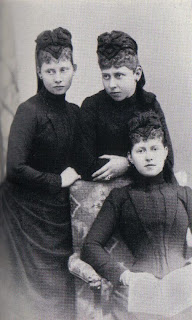
Showing posts with label Empress Frederick. Show all posts

"The Mind Is Its Own Place"


John Milton's wonderful line from ‘Paradise Lost’ : “The mind is its own place and of itself can make a heaven of Hell or a hell of Heaven” came to mind when I read a very interesting comment by ‘Anonymous’ on a previous post. Referring to Kaiser Wilhelm, s/he wrote:

“His parents were a happy marriage, so I don't know why he became such a complicated character. On the other hand, Emperor Karl grew up in a broken home, his father being an unfaithful husband and his mother a very strict and monotonous woman. That clearly shows that it's up to every person to decide what kind of human being she or he wants to become in life.”
I couldn’t agree more with the last sentence of this comment. Recently I was watching a TV drama in which someone, from the outside, had everything going for him but he was deeply unhappy due to his perception of, and emotional response to the events happening with other members of this family, which – inaccurately as it happened – left him feeling somehow unloved. Children see the world revolving around themselves. If parents are unhappy together, children often believe themselves to be the cause of their unhappiness. If, for some valid reason, which the child does not understand, parents leave the child with other people for a while, the child can feel abandoned. Children are so finely tuned that the slightest snub can seem like a disaster, and the tiniest observation can create immense awe and joy. Most of us dull that fine tuning as we grow up – and we are encouraged to do so by adults - in order to dull our extremes of painful or rapturous emotion. Whether we grow up in idyllic domestic circumstances (did anyone grow up in a thoroughly idyllic home where everything was always rosy?) or in very unhappy circumstances, it seems to me we have a choice. We can either become reactors/victims or creative and perceptive beings. How wonderful it would be to maintain a child’s fine-tuning alongside the wisdom that comes with understanding that, while we truly are the centres of our own universe (in that we have choice how to perceive every encounter and situation), everyone else around us is also the centre of his/her universe.

Kaiser Wilhelm, I think, had a reactor/victim mentality and was in such inner turmoil because he knew he needn’t be that way but couldn’t find a means of overcoming his own demons. The fact of his parents’ happy marriage probably added to his woes. His mother was little more than a child when he was born and she had very little say in his upbringing. Being so young and being a stranger in a foreign country and in a Court that was so different to the one in which she was raised, she felt powerless to influence Wilhelm when he was, almost from the moment of his birth, made the property of the Prussian Court, and had his head filled with grandiose notions from Bismarck and from his paternal grandparents. At the same time, because of the deformity of his arm, he was forced to endure countless hours of humiliation and painful treatments in a futile attempt to correct the deformity. A small child, seeing the love his parents had for each other, yet feeling excluded from that love, he always seems to view his deformity as the cause of his mother’s abandonment of him. To make matters worse, his mother was intellectually brilliant, and didn’t really ‘suffer fools gladly’ – after all, her own mother had been very quick to criticise her children so that was the normal pattern for Vicky. Wilhelm must have felt one minute stupid and weak, and the next minute, hearing Bismarck speak of his role as future Kaiser, amazingly powerful. It was a pattern he continued to act out all his life – swinging between victor and victim to such extremes.

At the outbreak of war, for example, his initial response to the Russian mobilisation was that of a victim. The Willy-Nicky telegrams and his own autobiography show him in an attitude of injured innocence – the poor victim of his family’s treachery. Within a week he was making grandiose and extreme announcements about how he would utterly decimate every British soldier who set foot on the Continent, and how every Russian prisoner should be killed without mercy. Who or what was he really railing against? His own sense of confusion and inadequacy.

The saddest part of his story is, I think, that he was intellectually gifted and he was capable of great love but his inner turmoil prevented him from ever finding balance or harmony within himself. The last video footage of his life shows him at Doorn, carving wood, playing with his dogs, behaving as he probably behaved in the happy hours he spent with his mother and family at Bornstedt (the country ‘farm’ his parents bought to create as normal a family life as possible for their children. There, he had played with local children and lived a ‘normal’ life and felt very close to his mother).

The contradictions in his character are fascinating, and are also a family trait. Few people could be as contradictory as Queen Victoria and several of her children and grandchildren...and perhaps the contradictions, magnified by the loftiness of their position, are what make these people so attractive even today. They mirror everyone’s contradictions in a way that is quite beautiful.

There is so much more to write of Wilhelm’s contradictions...

"The Last Link Is Cut Off" - More of Queen Victoria's Granddaughters

At the beginning of July 1897, Vicky returned from the Jubilee celebrations to her beloved Friedrichshof. There, between visits from her daughters and frequent trips to her beloved Italy, she continued to amass her artistic collections with the same enthusiasm she had shown as a child when collecting fossils to add to her collection in the Swiss Cottage. Friedrichshof was so full of antiques and treasures that, according to a regular visitor, Marie Louise, the ‘wonderful’ place became:
“..more of a museum than a house…I remember once…I went upstairs to my room and lay down on my sofa. My aunt came to see that I had everything I needed and seeing me reclining on the couch said: ‘Dear child do you not know that you are lying on a cinquecento coverlet!’ and she placed a newspaper over it although I had already taken the precaution of removing my shoes.”
Vicky’s concern for her antiques, however, did not prevent her from welcoming children into her home, and one of the chief delights of her widowhood was the pleasure she took in her grandchildren. It saddened her deeply that Willy’s wife seemed so intent on alienating her from their six sons and had acerbically pointed out that the choice of the name Victoria for their only daughter was not made out of deference to her grandmother. But while one daughter-in-law exacerbated the antagonism between Vicky and her son, her second daughter-in-law, Irène of Hesse, proved far more accommodating.
Since Irène’s marriage to Henry, in May 1888, the mutual and long-standing affection
between aunt and niece had deepened, not least because Irène had done so much to improve relations between Vicky and Henry. Life with the Kaiser’s volatile brother was not always easy for the Hessian princess:
“[He] was a tall and handsome man, but inclined to be - let us say - temperamental. At times he was overbearing and very satirical, and at others friendly and charming. His wife was a small woman, simple in manner and of a kindly, unselfish nature.”
Notwithstanding her docility, Irène succeeded in calming his fiery temper and by the time of the Diamond Jubilee, Queen Victoria’s lady-in-waiting, Marie Mallet thought him ‘simple friendly and courteous…the nicest male royalty going.’
The couple had settled in the Königliches Schloss in Kiel from where Henry continued his naval duties and indulged his passion for motor cars and engines, and to where, in March 1889, Vicky and Moretta had hurried to assist Irène through the birth of her first child.
Suffering none of Queen Victoria’s revulsion about the ‘unecstatic and animal’ state of pregnancy, Vicky set to work preparing the nursery and layette for the baby. Though the welcome she received was cordial and her efforts were greatly appreciated, she could not help but feel disappointed to find so few books in the house. It seemed incongruous that the well-educated daughter of Princess Alice showed so little interest in world events and was unable to discuss matters of political importance. Vicky may well have agreed, too, with Marie Mallet’s view that Irène’s ladies-in-waiting were ‘very dull and by no means easy to get on with.’
But if Vicky wanted reassuring that this truly was Alice’s daughter, she needed only to recall how easily her sister had shocked the Queen by breast-feeding her baby. Now it was Vicky’s turn to be appalled when Irène made no attempt to hide her pregnancy behind shawls and rugs, but appeared quite openly in public right up to the time of the birth.
“I think it quite embarrassing,” Vicky wrote prudishly to the Queen, “and would never have dreamed of doing so especially before gentlemen and children and strangers.”
Embarrassed or not, she remained at Irène’s side through the ‘quick, easy’ birth of a son, Waldemar, on 20th March 1889. The baby’s healthy appearance belied a terrible truth. It soon became clear that Waldemar was a haemophiliac, which perhaps accounts for the seven-year gap before Irène gave birth to a second child, Sigismund. Four years later the family was completed with the birth of a third son, Henry.
“I wonder that you are pleased at Irène’s having a third boy.” Queen Victoria wrote to Vicky, “There are far too many princes in Prussia.”
There was an unfortunate irony in the remark, for even as Irène was hoping for a daughter, her younger sister, Alix, Tsarina of Russia, was still desperately praying for a son.
Boys or girls, Vicky delighted in her grandchildren and looked forward with pleasure to Sophie’s frequent visits to Friedrichshof with her large family or the arrival of Mossy and Fischy with their twins. Between and during their stays she continued to enjoy the beautiful scenery of Krönberg walking and riding daily as she had done since childhood, until an accident brought her outings to a sad conclusion.

In September 1898, while out riding with Mossy, Vicky’s horse ‘took fright at a steam threshing machine…and shied violently.’ Vicky was thrown from the saddle but, though bruised and badly shaken, was able to write the next day to her mother that:
“I got up and walked part of the way home and only felt shaken and stiff towards evening…I am alright today except for a headache.”
In reality, Vicky was far more ill than anyone realised. Throughout her life, she had been troubled by a myriad of rheumatic ailments but following the accident she suffered severe back pain, which intensified with the passing of time. After consulting several doctors who presented conflicting medical opinions, she was eventually diagnosed with breast cancer, which had spread to her spine. Determined to continue living life to the full, she kept the news from her family, referring to her pain simply as lumbago and confiding the truth only to her youngest sister, Beatrice, and their mother.
For several months, she was able to make her regular excursion to Italy and France until, by the end of 1899, the pain left her confined to bed for long periods and she had no alternative but to reveal the truth to her daughters. Charlotte was the last to be told and though she, like the others, promised to keep the news to herself, she immediately announced her mother’s illness to the world.
Mossy, Moretta, and Irène were on hand to offer what comfort they could and Sophie hurried from Greece to be at her mother’s side. Vicky endured her sufferings with fortitude and a touching concern for others, apologising to her nurses for upsetting them by her screams. Yet, hard as she tried to maintain a positive outlook, the pain, relieved only by minimal amounts of morphine, was excruciating and, at its height, she refused to see anyone for fear of causing them distress:
“My legs are shrunken and falling away to nothing, a mere skeleton,” she wrote to Sophie, “The agony is as bad as ever, the nights are a torture…The tears and groans all night long drive me utterly mad. I often think I should put an end to myself if only I could. Oh I cannot bear it any longer!”
So loud were her cries of agony that even the soldiers guarding her palace requested permission to move out of earshot.

For Queen Victoria, her eldest daughter’s illness was but one in a series of heartaches that marred her last years. In the closing years of the century, she mourned not only for Liko, for Young Affie and the Duke of Edinburgh and Coburg, but as the mother of her country, she grieved too for the young officers dying by the dozen in the South African War. Her concern for the soldiers was genuine and she repeatedly sent telegrams assuring them of her gratitude whether in victory or defeat. Though the Queen never doubted the justice of the British cause, the conflict bore an ominous portent of the division that a future war would wreak in the family.
Vicky and her three younger daughters supported the British and shared the Queen’s concern for her troops. From Sophie in Athens, from Vicky in the Friedrichshof and from Mossy in Hesse-Kassel, parcels arrived for the English soldiers, while the princesses studied British newspapers for reports of the cruelty and treachery of the Boers.
Across much of the rest of Europe, however, a different story was told. In Russia, Alix and Ella read reports of the British atrocities and the claim that their grandmother’s soldiers were using Boer women and children as shields.
“We…are right behind the Boers and wish them every success in the war,” wrote the Tsar’s sister. “I think there can be no one (except the English) who isn’t on their side!”
Even Tsar Nicholas, who claimed to discuss the matter every day at dinner, agreed with his sister, leaving Alix torn between loyalty to her grandmother and her husband.
“She is, of course appalled at the loss of English officers,” Nicky wrote, “but what can you do, it has always been like that in their wars!”
From Prussia, too, the Kaiser - while pompously offering his grandmother advice on how best to proceed - praised the Boers’ successes. In Germany ‘the antagonistic feeling…against England was very pronounced,’ making life especially difficult for those English princesses, Marie Louise of Schleswig-Holstein and Alice of Albany, who were living in there. Alice’s brother, as a German officer cadet had no option but to support the Kaiser’s view, while for Marie Louise, who had one brother, Albert, in the German army and another, Christle, serving with the English forces, the situation was still direr.
Christle, a Captain in the King’s Own Rifle Corps, had heroically come
through ‘many hardships’ in the campaign until, like his Uncle Liko before him, he contracted malaria and enteric fever. His sisters, anxiously awaiting news at Balmoral, heard that he was being well treated in the military hospital in Pretoria, but within days pneumonia had set in and he died on 29th October 1900. At his own request his body was buried alongside his fellow officers in Pretoria.
“Dear unselfish Princess Thora [is] just heart broken,” wrote Marie Mallet, “she cared more for her brother than for anything on earth and was justly proud of his valour…[She] is admirable, although she and her mother will miss him every hour of every day…she thinks of everyone but herself.”
It was left to the heart-broken Thora to take the news of the death of yet another grandson to the Queen.
“I cannot write but a few words, as we are in such distress about dear beloved Christle’s loss.” The Queen told Vicky, “…Poor dear Lenchen bears up wonderfully; so too does poor dear Thora…”
Even as she wrote the letter, Queen Victoria was filled with anxiety for the future of its recipient, for by then she knew that Vicky herself was dying.

The series of bereavements, Marie Louise’s divorce, anxieties about Vicky and the stress of the war brought about a rapid deterioration in Queen Victoria’s health.
“She said,” wrote Marie Mallet in the summer of 1900, “that the trials and sorrows of the last few months were almost more than she could bear and, alas, I cannot help feeling that there may be more in store.”
Her sight was failing and, scarcely able to walk any distance, she spent much of her time in the company of her granddaughter, Thora, who patiently sat at her side, listening even as her mind began to fail and she rambled occasionally incoherently of events of the past.
Shortly before Christmas 1900, Queen Victoria left Windsor for the last time, setting sail for her beloved Osborne House on the Isle of Wight. It was a cold, bleak winter and, the frail Queen was visibly fading.
“My sight is rather bad since I have been poorly,” she wrote to Vicky on 6th January, “but I hope it will soon be much better.”
It was not to be. Within a fortnight, telegrams were flying across the continent warning of her decline. Princesses hurried to the island to take their turn in approaching Grandmama’s bed to whisper a last good-bye. Racing, too, across the Solent, much to his aunts’ distress was the Queen’s eldest grandson, Kaiser Wilhelm II, who genuinely wished to see her for one last time. Throughout the 22nd January the Queen lapsed in and out of consciousness and shortly before noon she seemed so close to death that the royalties were summoned to her bedside. As her chaplain, Dr. Davison began his prayers the Queen was able to recognise the members of her family: Victoria Battenberg, who was staying on the Royal Yacht Osborne; the Dowager Duchess of Coburg and her little grandchild, Ducky’s daughter, Elizabeth of Hesse. Daisy and Patsy Connaught arrived with their parents and joined the Prince of Wales and the Queen’s younger daughters, Lenchen, Louise and Beatrice in their vigil. For a few hours she rallied and the family withdrew but by mid-afternoon she had suffered a relapse. At half-past six in the evening of 22nd January 1901, Queen Victoria, died in the Kaiser’s arms.


Ten days later, a long procession of royal mourners followed the coffin towards the yacht Alberta that was to take the Queen’s body back to England. On 4th February, through flurries of snow, the cortege set out from the Albert Memorial Chapel in Windsor to Queen Victoria’s final resting place beside beloved Albert in the Mausoleum at Frogmore. For Marie Louise, standing beside the coffin brought a deep sense of ‘peace and awe’, but, in typical Wales’ fashion, her cousin, Maud, confessed that she found the funeral procession to ‘rather trying & exhausting.’
“I cannot believe that she is really gone, that we shall never see her anymore. It seems impossible,” wept the young Tsarina Alix, whose fourth pregnancy had prevented her from making the journey to England. “How I envy you [she wrote to her sister, Victoria] being able to see beloved Grandmama being taken to her last rest.” A memorial service was held for the Queen in St. Petersburg where, for the first time since her arrival in Russia, the Tsarina wept in public.
While Ducky avoided the funeral, remaining in France with her Russian lover, her elder sister, Missy, was deeply distressed at being prevented from accompanying her husband to the ceremonies. She sensed the implications of the loss of ‘dearest grandmama’ and in a letter to her mother described her longing to return to England:
“To see it all again if only for a day or two…to have a last peep at the old house…with out dear old Granny the last link is cut off!...I tell you it is inconceivable sorrow for me.”
For Alice Albany, who had returned from Germany for the funeral it was an equally devastating experience:
“I had come to regard her as permanent and indestructible - like England and Windsor Castle.”
But it was the future Queen Mary who, perhaps, most accurately expressed the country’s sense of bewilderment:
“The thought of England without the Queen is dreadful even to think of. God help us all.”

Grief-stricken at the death of her grandmother, Mossy of Prussia faced the most difficult task of all. It fell to her to break the news to her mother. Vicky heartbroken and racked with pain, wept “I wish I were dead too!”
For six more months, she struggled on, her agony increasing by the day. In February 1901, she received a final visit from her brother, the new King Edward VII. In spite of the friction between Willy and ‘Uncle Bertie’, the encounter passed off amiably enough, thanks largely to the tact of Sophie and Mossy who ‘were always ready to dash in if the conversation seemed to get into dangerous channels.’ Bertie was horrified by his sister’s rapid deterioration; as she sat ‘propped up with cushions; she looked as if she had just been taken off the rack after undergoing torture.’ Before they left, the king’s physician Sir Francis Laking persuaded her doctors to administer larger doses of morphine to combat her pain.
Through the last few months of her life, Vicky’s daughters and daughter-in-law, Irène, visited regularly, Mossy and Moretta barely leaving her side. To the end she continued to take an interest in current events and in her daughters’ futures; when Sophie arrived from Greece, Vicky urged her to continue to care for the poor of her country. To the last, too, Vicky remained first and foremost an English princess. To her friend Bishop Boyd-Carpenter, she confided that she hoped he would preside at her funeral and read the English Burial Service over her.
In the early evening of August 5th 1901, Vicky, surrounded by her children, died reciting the Lord’s Prayer. The funeral service she had requested was carried out at the English Church Homburg, to be followed some days later by a Lutheran funeral at Krönberg, after which she was interred with Fritz at Potsdam. In her will she left her favourite home at Friedrichshof to her youngest daughter, Mossy.

The death of Queen Victoria severed the tie uniting the royal cousins. Without her as their mainstay, there would be no common bond to keep the family together. With the dawning of the new century, the old world had passed away and the ominous clouds across the Solent portended a future far bleaker for the family that anyone could have predicted.

"My Benjamin" - More of Queen Victoria's Granddaughters


By 1893, the Empress Frederick had completed her work on the Friedrichshof and settled comfortably into her new home with her youngest daughter, Mossy. Between riding, reading and writing interminable letters, she devoted much of her time to philanthropic activities. In Krönberg, she founded and regularly visited a hospital, built almshouses and established a school but her chief concern, as ever, was her family. Loath as she was to part with her youngest child - ‘my Benjamin,’ - it was time to seek out an appropriate husband for Mossy.
Already several suitors had been suggested, among them the young Tsarevich Nicholas, but he, in love with Alix of Hesse, declared he would rather become a monk than marry the Prussian princess, while, for her part, Mossy had no intention of converting to Orthodoxy, as was required of a future Tsarina. In 1891, Queen Victoria proposed a more suitable candidate - Mossy’s cousin, Eddy, Prince Albert Victor, Duke of Clarence and Avondale. As the eldest son of the Prince of Wales, Eddy was second-in-line to the throne and Queen Victoria had little doubt that princesses would be queuing up to ascend to ‘the highest position there is.’ It came as a shock to discover that she had vastly overestimated her beloved Eddy’s attraction.
In truth, though his mother and sisters adored him, there was little about the feckless young man to appeal to an intelligent princess. A very poor scholar, listless and lethargic, he had inherited his mother’s deafness and was so dependent upon his younger brother that even when he spent a brief stint in the navy, George was sent with him. His gentleness had some appeal, and cousins and courtiers alike often praised his childlike kindness.
“He is very much to be liked,” wrote Lord Wolseley, “has most excellent manners, thoughtful for others & always anxious to do the right thing. He is however young for his age and requires to be brought out.”
Efforts to ‘bring him out,’ soon proved futile. Indolent and apathetic about affairs of state, his only enthusiasm was for pleasure and by the late 1880s it was rumoured that he was bisexual and had contracted syphilis. If there were any truth in the rumour, it must have escaped the Queen’s notice or she would not have been so keen to promote a match between Eddy and one of her favourite granddaughters.
In spite of the Prince Consort’s warnings of the need to bring new ‘dark’ blood into the family, Queen Victoria favoured marriage between first cousins - after all, she and Albert had been cousins and since their progeny cluttered the Courts of Europe, there were few available royalties who were not somehow related. Of all Eddy’s cousins none seemed, in Queen Victoria’s eyes, better suited to the role of future Queen Consort than the intelligent and devoutly religious Princess Alix of Hesse.
Since her mother’s death, Alix had spent a good deal of time at the English Court and held a particularly high place in her grandmother’s affection. Her Hessian good looks were sure to appeal to the sensuous Eddy and, more to the point, in the Queen’s view, betrothal to her cousin would distract her from the handsome Tsarevich, to whom she had lost her heart while visiting her sister, Ella, in Russia.
For Ella, who was busily promoting that match, the idea that Alix should marry the hapless Eddy was ‘absolutely ridiculous.’ Apart from his physical frailty, he was ‘quite stupid’ and though his genuine kindness had its appeal, he held no real attraction for Alix. For several months, under sustained pressure from both families, she wavered until at last she gently refused his proposal, informing him that:
“…She knows she would not be happy with him and that he would not be happy with her and that he must try not to think of her.”
It was not the first time that one of her Hessian granddaughters had thwarted the Queen’s plans for a family wedding, but she resigned herself to the outcome and wasted little time with regrets. There were other granddaughters of the right age and temperament - Mossy of Prussia, for instance.
Unlike Cousin Alix, Mossy was not, in her grandmother’s opinion, ‘regularly pretty’ but she had ‘a pretty figure, is very amiable and half English with great love for England which you will find in few if any others.’
The prospect of her daughter happily settled in England, delighted Vicky and when she received a letter from Mossy’s sister, Sophie, describing Eddy as ‘such a dear & so good & kind,’ she needed no further assurance. In February 1891, Mossy accompanied her mother to Paris, where French journalists wrote several complimentary descriptions of the svelte, blonde, Prussian princess. From there they journeyed to England for a holiday at Sandringham in the hope that Mossy and Eddy might fall in love. The plan was doomed from the start. By then Eddy had become infatuated with the daughter of the deposed French Emperor, Hélène of Orleans, and Mossy was in the throes of an unrequited ‘malheureuse passion’ for a German cousin, Max of Baden. It soon became apparent there was even less chance of pairing Eddy with her than there had been with Alix of Hesse.
It was probably just as well. The Princess of Wales would never have approved of matching her ‘little boy’ with a Prussian and much preferred the Catholic Hélène, whom Eddy was meeting regularly at the home of his sister, Louise. Eventually, at his mother’s prompting, he even went so far as to propose to the French princess before rushing her off to the Queen to announce their engagement. Touched as she was by the romance, as a constitutional monarch Queen Victoria was powerless to intervene. The law prevented the heir to the throne from marrying a Catholic, and even when Hélène offered to seek a papal dispensation to convert to Anglicanism, ministers pointed out that it would be impossible to receive the deposed Emperor’s daughter without damaging England’s relationship with Republican France. Eddy resigned himself to the inevitable and within a year had proposed to and been accepted by his childhood friend, Princess May of Teck.
Queen Victoria was satisfied with the outcome, considering May ‘a vy. pretty girl – very sensible & well informed, a solid girl wh. we want’ but not everyone in the family shared her delight. To Vicky she seemed:
“…a little stiff & cold! I hear her praised on all sides & by those who know her well…She is certainly very nice in manner -&c but I do not think she has much charm or is very fascinating! She may have been shy…”
The jealously protective Princess of Wales, while conceding that May would make a reliable wife, was reluctant to hand over her precious son to any other woman and Eddy’s equally possessive sisters could be as cutting as their mother when they wished. ‘Poor May! Poor May with her Wüttemberg hands!’ mocked the unprepossessing Louise, while her insipid sister, Toria, remarked to a guest, ‘Do try to talk to May at dinner, though one knows she is deadly dull.’
In Cumberland Lodge, Aunt Lenchen, too, was most put out that Eddy had chosen the lower-born May before her own eligible daughter, Thora. In the event, the complaint was immaterial. During the bitterly cold January of 1892, the Waleses gathered at Sandringham for Eddy’s twenty-eighth birthday. It was hardly going to be the most thrilling event; his brother, George, was recovering from typhoid, frail Toria was in bed with ’flu’ and most of the rest of the family had colds. On the day before his birthday, while out shooting with his father, the prince became ill and returned to the house to join the other invalids. The following morning he managed to make a brief appearance to open his presents, but was too weak to participate in the planned festivities. That evening influenza was diagnosed and on 10th January, the Queen recorded in her diary:
“Was startled and rather troubled by a telegram from Bertie saying dear Eddy had a ‘very sharp attack of influenza and had now developed pneumonia in left lung, the night restless but strength maintained.’”
For four more days, while his anxious mother and sisters sat mopping his brow, he drifted in and out of consciousness, repeatedly whispering ‘Hélène,’ until, in the early morning 14th January 1892, he died surrounded by his family. Even the sheltered world of the Waleses was not immune to tragedy.
“In this our overwhelming grief,” Toria wrote to her grandmother, “it is almost impossible to believe that our beloved Eddy has been taken from us. How I wish dear Grandmama you could have seen him as he lay there, as a saint or a knight, with a heavenly peaceful expression on his lovely face.”
A saint he most certainly was not, but his sister, Louise, was equally effusive in her praise:
“His was such a gentle, kind and affectionate nature, that everyone was devoted to him, and it is some consolation to me to know that his memory will be cherished by all his relations and friends. We are all heartbroken and I am sure we shall never quite get over it.”
To the country at large the death of this most unsuitable monarch-in-waiting came as a blessing, but his sisters’ grief was genuine and the Princess of Wales never did ‘quite get over’ the shock. Almost twenty years later, during the Coronation of George V, she was heard to whisper, “It should have been Eddy.”

In the Friedrichshof, meanwhile, Mossy recovering from her infatuation with Max of Baden, met and fell in love with the scholarly Frederick ‘Fischy’, a brother of the Landgrave of neighbouring Hesse-Kassel. He may not have been the most illustrious of princes, but Vicky, more concerned with Mossy’s happiness than her position, was delighted:
“He loves her devotedly,” she wrote to the Queen, “and is really a very nice boy, so steady and quiet though rather timid and delicate looking. He is intelligent and cultivated with a taste for learning and art and writes charming poetry. He is not rich and does not possess a place of his own but he is quite comfortably off.”
Queen Victoria’s response was typically guarded. Although she had recently been pressing for a match with Prince Albert Victor, she now decided that it would be better for Mossy to remain single to devote her life to the service of her widowed mother. Happily, Vicky had no intention of putting the same pressure on Mossy as the Queen had once put on Beatrice and, putting aside her own feelings, willingly gave them her blessing.
The usual gathering of royalties arrived for the wedding in Potsdam on 25th January 1893. From England Queen Victoria sent, among other gifts, a ring for the bride. Willy, despite his complaint that a mere Landgrave was unworthy of the Kaiser’s sister, behaved himself well and only the brother of the straight-laced Empress Dona marred the occasion by entertaining the visiting Tsarevich with dancing girls and plying him with so much drink that he could barely stand.
Mossy and Fischy moved into the peaceful Schloss Rumpenheim - an ancient castle, given to them in trust by Fischy’s elder brother - and began what was to be probably the happiest marriage of all Vicky’s daughters. The Queen’s fears that Vicky would be lonely once Mossy had left home proved largely unfounded. She and Fischy regularly stayed at Friedrichshof where their cordiality impressed all who came to visit. Vicky’s admiration for her studious son-in-law increased by the day; he shared her love of art and architecture, and repeatedly in her letters to Mossy, she ‘wished’ that Fischy could have been with her to share a particular experience, a scenic view or impressive building. She trusted his judgement so implicitly that she came to rely on his advice in political and family matters.
Within days of the wedding Mossy conceived her first child, causing her grandmother to sigh:
“Poor thing, I pity her so much. It is really too dreadful to have the first year of one’s married life and happiness spoilt by discomfort and misery.”
It worried the Queen too, that the draughty old Schloss was unsuitable for a woman in an ‘unhappy condition’ but in October 1893, Mossy’s gave birth to a healthy son, Friedrich. The following year a second son, Max, was born, to be followed in 1896 by twin boys, Philip and Wolfgang, an event which delighted the Queen who ‘laughed very much and is rather amused at the list of her great grandchildren being added to in such a rapid manner.’
A second set of twins Christoph and Richard was born in 1901. Like their parents, they were gentle studious boys who, unlike their Prussian cousins, had no appetite for militarism. Alice Topham, the English governess to Willy’s daughter, recalled a visit they made to Berlin in 1903. Standing beneath a painting of a great Prussian victory, eight-year-old Max said,
“My father says war isn’t like that at all. He says it’s not so clean and bright and that shells tear the men and horses to pieces and it’s horrible.”
In little over a decade, Max and his brothers would realise the tragic accuracy of his father’s words.•

"Happiness Is Not To Be Hers" - More of 'Queen Victoria's Granddaughters'


When the Empress Frederick and her daughters returned to Germany in the early spring of 1889, their immediate priority was finding a suitable home. The former Crown Prince’s Palace in Berlin that Willy now offered was too close to Court to appeal to the Empress, who spent several months viewing other, more appropriate, properties. One place in particular appealed to her: an old country house set in the beautiful countryside of Krönberg in the Taunus Mountains, not far from Homburg and Frankfurt.
“The position, the view are so lovely,” she told Queen Victoria, “and the air delicious and what walks and drives all around!”
Appealing as it was, the old house was dilapidated and Vicky doubted she had sufficient money for a complete renovation until a stroke of good fortune finally came her way. An old friend, the Duchess of Galliera, had recently died, leaving the Empress a large legacy which gave her the financial independence to rebuild the property.
It was a slow and time-consuming project but Vicky, utilizing her artistic talents to the full, delighted in the task which distracted her not only from her recent bereavement but also from the militaristic regime that her son was espousing in Berlin. Employing only the finest artists and craftsmen, she intended to make her new home a fitting tribute to Fritz’s memory, and the eventual outcome was Friedrichshof - a name chosen by Moretta - the home that the Empress Frederick would occupy and love to the end of her life.
“The house is very like an English country house,” wrote Fritz Ponsonby, “…Herr Ihne, the architect who built it, was half English, and fell in at once with the Empress Frederick’s idea of making it like an English country house. The bedrooms seemed quite English except for the stove. Otherwise the house was like a museum filled with a collection of works of art and curiosities.”
The absorbing venture, however, did not distract Vicky from considering her daughters’ futures and throughout the summer of 1889 she most preoccupied with the imminent wedding of her daughter, Sophie.
While Moretta moped about the Court in a desperate search for a husband, her younger sister had long seemed destined for a throne. At one time, she had been considered as a bride for the Russian Tsarevich Nicholas, but while visiting Marlborough House during Queen Victoria’s Golden Jubilee celebrations, she met and fell in love with the Princess of Wales’ nephew, the Duke of Sparta, Crown Prince Constantine (Tino) of Greece.
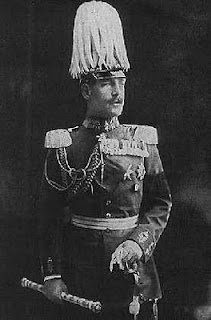
Queen Victoria was among the first to see the possibilities of a match between her ‘very sweet’ granddaughter and the attractive young soldier. Though she realised he was not the cleverest of men, she was sufficiently impressed by his looks and charm to ask Vicky:
“Is there any chance, of Sophie’s marrying Tino of Greece? It would be very nice for her for he is very good.”
Two months later, the engagement was announced and a date set for an autumn wedding, the following year. Vicky’s delight at the prospect of seeing her daughter as future Queen of the Hellenes was tempered by the thought of having to part with ‘dear little’ Sophie but at least she could take comfort in Queen Victoria’s assurance that, although Greece was far away, ‘she is sure to have a happy home.’
Practical matters, too, concerned the Empress Frederick as Sophie prepared to leave for Athens. As she reflected upon the inadequacies of the Greek medical services she recalled her own traumatic first childbirth, and was determined to spare her daughter the same ordeal. Knowing from bitter experience how strongly foreign Courts resented outside intervention, she conceived a plan to include an English midwife disguised as a lady-in-waiting in Sophie’s entourage.
At four o’clock in the afternoon October 25th 1889, Sophie, her mother, sisters, and the midwife arrived to a rapturous welcome in Athens. The buildings between the Royal Palace and Cathedral were draped with flags and banners and the crowds turned out in force to greet their future Queen, who ‘bore herself so nicely, and was gentle, quiet and composed.’ Royalties arrived from all over Europe: Tino’s grandparents, the King and Queen of Denmark; the Russian Tsarevich Nicholas; the Prince and Princess of Wales; and eventually the Kaiser and Kaiserin, accompanied, to everyone’s surprise, by their own chaplain.
King George (the Danish born brother of the Princess of Wales) had gone to great lengths to ensure that the wedding would pass smoothly and, as Sophie and Tino had agreed that the service would be conducted according to both the Orthodox and Lutheran rites, he had appointed his own personal chaplain to preside over the Protestant ceremony. The arrangement suited everyone but Willy. Hardly had he set foot ashore when, with typical tactlessness, he announced that he and his strictly evangelical wife were unhappy with the Greek king’s choice and insisted that their own dogmatic chaplain should lead the service instead.
“This they announce…without asking or consulting me or Sophie!!!” Vicky gasped to her mother, “…Most likely Dona knew that I & Sophie would object, therefore it was done behind my back.”
Willy’s interference apart, the wedding took place on the 27th October 1889 and passed without incident. The bride and groom moved into an Athenian villa that was to be their official residence for the next twenty-four years. In the summer heat, they were able to escape to their favourite home - a small cottage in the mountainous Tatoi Woods, where Sophie, almost as much an Anglophile as her mother, had the rooms decorated in ‘the English style.’ There, she and Tino followed the English routine of a good breakfast in the early morning, a light luncheon at midday and, after a siesta, afternoon tea. Far from the stiff formality of the Prussian Court, the Crown Prince and Princess lived a relatively simple life, swimming in the sea, tending their gardens, planting trees, and growing flowers.
Vicky’s foresight in appointing the English midwife proved necessary sooner than anticipated. Eight months after the wedding, in the sweltering heat of July 1890, Sophie gave birth to a premature son, George, causing Queen Victoria to comment:
“What shall I say about this most unfortunate and fortunate event happening so soon?…It must be at least a week too soon for she won’t have been married nine months till the 27th.”
Vicky and her younger daughters, who had hoped to be present for the birth, arrived too late, and by the time they reached Athens in August, they were horrified to find Sophie in a very poor state and ‘nothing but a little skeleton.’ In spite of the presence of the English midwife, she had suffered terribly at the hands of three inexperienced doctors leading a squeamish Queen Victoria to warn Vicky to shield Sophie’s sisters from the ‘unedifying and for the future alarming details.’
Three years later, a tragic event in her household threatened Sophie’s second pregnancy. Among her staff was a young nursery maid named Marie Weber, whom Vicky had recommended and sent to Greece from Germany. One afternoon, the unhappy Marie climbed to the top of the Parthenon and threw herself to the ground. She died later that evening.
“Is this not too dreadful!” Vicky wrote to her mother, “Poor unfortunate - miserable girl! How could she commit such a piece of sin and folly! She must have been mad…You can imagine my anxiety - for such a shock & such scenes - should harm my Sophie.”
It was left to Mossy to break the news to Marie’s parents.
Sophie, though distressed, was unharmed and five months later gave birth to a second son, Alexander. For him and for her subsequent children - Helen, Paul, Irene and Katherine, born at irregular intervals, between 1896 and 1913 - she employed only English nannies.
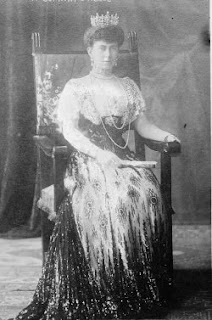
With Vicky’s encouragement Sophie dedicated herself wholeheartedly to her duties as Crown Princess. In true family fashion, she established schemes to improve the medical services and implemented forestation programmes to aid agriculture. But, for all her good intentions, her efforts were not always well-received. While she despaired of the Greeks’ lack of enthusiasm for her projects, they found her stiff Prussian temperament overbearing and she lacked the personal magnetism to win great popularity.
More wounding for Sophie was the realisation that Tino was not quite the faithful and ‘very good husband’ that Queen Victoria had envisaged. Having been raised by parents who were totally devoted to one another, it came as a shock to discover that Tino thought nothing of entertaining mistresses and embarking upon several affairs. In desperation Sophie turned to her father-in-law, the king, for advice but his response was far from encouraging:
“Consult your dear mother-in-law; she will be able to give you the best advice on this point.”
The disappointment of Tino’s infidelity and the lack of warmth shown her by the Greeks soon smothered much of Sophie’s early enthusiasm. Her pessimism and gloom increased with age, so much so that Victoria Battenberg commented:
“Sophie indulges in the true German ‘Empfindlichkeit’, [sensitivity] a defect which really is at times worse than a vice.”
The high-spirited Missy of Edinburgh put it even more succinctly: ‘she bored me.’ Perhaps Missy had little patience with her cousin’s complaints, for by then, in her own idiosyncratic fashion she had found a far more effective way of dealing with a husband’s infidelities.

Returning to Germany after Sophie’s wedding, Vicky knew very well that after the Sandro debacle Moretta would not settle contentedly into what her grandmother piously called a state of ‘blessed singleness.’ Unlike her Hessian cousins, Moretta had been raised with only one purpose in mind and could envisage no other future than that of a wife. The trauma of Sandro’s departure, spurred her on to a desperate search to find a husband, and cousins and courtiers alike were persuaded to assist in her quest. For political reasons Bismarck advocated the son of the Portuguese king but since that would entail converting to Catholicism, Moretta declined. Queen Victoria examined the possibility of a match with a Swedish prince but, receiving reports of his unsuitability, concluded that he was too young and Moretta:
“Would be more likely to be happy with someone a good deal older than herself and who had, like herself, loved someone before.”
Her aunt, Marie of Edinburgh, who ‘would do anything to help,’ recommended two of her own Russian cousins, Grand Dukes Sandro Mikhailovich and Pyotr Nikolaevich and, in spite of her aversion to all things Russian, Queen Victoria raised no objections:
“I think…she would not be unhappy in Russia with Ella & Minnie [the Empress Marie Feodorovna] etc…”
Moretta was intrigued by the prospect of meeting the dashing Sandro Mikhailovich but, as with the earlier Sandro, her dreams led only to disappointment. Her hopes of an encounter were repeatedly dashed and it soon became clear that the Grand Duke already set his sights on the Tsar’s daughter, Xenia, while Pyotr Nikolaevich was courting a Montenegrin princess. Various other royalties were mentioned and forgotten and, as one after another they slipped from her grasp, an increasingly despondent Moretta became convinced that she was too fat and too ugly to attract anyone. In despair, she launched herself on a drastic diet.
“Her one craze is to be thin,” Vicky wrote to the Queen. “She starves completely, touches no milk, no sugar, no bread, no sweets, no soup, no butter, nothing but a scrap of meat and apples which is not enough. She will ruin her health. She has a fine strong constitution. She goes to bed too late and takes almost too much exercise. I have begged and prayed, ordered, threatened, all to no effect. She is quite fantastical on the subject.”
With typical good sense, Queen Victoria decided to take her anorexic granddaughter in hand. In June 1889, she invited her to England where she kept a close eye on her, even allowing her to share her own sleeping carriage on the train to Balmoral from Windsor. She regulated her diet and encouraged more moderate exercise but by then even a fond grandmother was coming to believe that it was unseemly and degrading to go on frantically pursuing false hopes. To Moretta’s chagrin, she advised that, after so many disappointments, it would be better to abandon the pursuit for a husband and resign herself to spinsterhood. To make matters worse for Moretta, the presence of Sandro’s brother and sister at Balmoral revived old wounds and the announcement of the engagement of her younger cousin, Louise• added to her despair:
“Nothing but engagements all around,” she wrote to her mother, “- each house or place I go to - I see nothing but bright, radiant faces - one after another they marry - young than myself & I!!”
At twenty-three, Moretta was quickly growing beyond marriageable age. Her elder sister, Charlotte, and three of her Hessian cousins had married before their twenty-second birthdays and, as though to rub salt into the wound, her younger sister, had already married.
“Each time I hope for a thing,” Moretta wrote gloomily to her mother, “its sure not to take place & I shall never never marry – all my relations, sisters, friends do, except my stupid self. I am too ugly and nobody will have me – nothing but disappointments & bothers is my lot in this life - & for the future I shall try and put all hope out of my head.”
Moretta tried briefly to put all hope out of her head but finding the state of singleness anything but blessed, she was not to be dissuaded. Everywhere she looked she saw men with whom she dreamed she might be happy and redoubled her relentless pursuit of love so frenetically that Willy was cruel enough to observe that she would marry ‘anyone who was manly.’ His comment was not entirely inaccurate. Even Vicky was afraid that she might throw herself at any available young man who showed an interest in her, while Queen Victoria warned against allowing her to mix too freely with ‘unsuitable’ people. It almost came as a relief to them both when a minor German Prince, Adolph of Schaumburg-Lippe, arrived in Homburg and seemed quite taken with the lonely princess.
“He is not clever,” wrote Vicky, “and I believe he has learned but very little, as his parents gave him no opportunity…I think one can call him good-looking with an amiable expression…he is a little shy and awkward…Much polish and outward refinement he has not, but he is so civil and polite and makes a good impression.”
The rather scruffy soldier prince was neither well educated nor well travelled, but he had good health and a respectable reputation and when, within days of their first meeting, he proposed Moretta accepted him.
‘In her depression & discouragement,’ her mother told the Queen, ‘feeling that the happiness she had hoped for is not to be hers, she accepts this.’
The following June, Adolph was whisked off to Windsor for inspection by his future grandmother-in-law. In spite of the satisfactory - if somewhat uncouth -impression he made upon the English Court, Moretta herself was hardly enthusiastic about her prospective groom. Only months before the wedding Vicky wrote to Sophie that:
“[Moretta] is still in a state of mind about his beard and his clothes and his servant, who has very untidy German ways, but I tell her that will come alright.”
It was not a love-match; it was widely rumoured that Moretta did not even like her husband and was marrying solely ‘for the sake of marriage’ but at least she would be free of the stigma of spinsterhood and could look forward to raising a family of her own.
In the evening of 19th November 1890, wearing the veil that her mother had worn to her own wedding thirty-three years before, Moretta made her vows in a civil ceremony in the old Schloss Berlin before moving on to the chapel for the religious service. Though attended by numerous foreign royalties including the Crown Princes of Greece and Roumania, it was a relatively simple affair by royal standards as many of the traditional festivities were curtailed because of the Empress Dona’s pregnancy. Even so, according to one guest, Cousin Marie Louise, the celebrations lasted long enough to become monotonous:
“There was of course, a wedding feast and afterwards the traditional torchlight procession, when the bridegroom, preceded by pages, holding in their hands candelabra…had to lead each princess right round the room bowing to the Emperor and Empress. The best man then led the bride around the room in the same manner, and all the princes and princesses did likewise. You can imagine how long this took and how very bored we became.”
As Marie Louise found distraction elsewhere•, a weeping Moretta prepared to say goodbye to her family. The prospect of leaving her mother cast a shadow over the celebrations, and her leave-taking was not made any easier when Willy entered into a dispute with his sister, Sophie, which would take five years to resolve.•
Late in the evening, amid many tears:
“The bridal pair left for their honeymoon [in Egypt]. Instead of distributing wedding favours as we know them, the bride distributed her ‘garter’. This consisted of pieces of white satin ribbon, rather like a bookmarker, with initials, crown and date inscribed upon them.”
If Moretta was not exactly in love with her husband, she at least had the joy of discovering that by the end of her honeymoon she was pregnant. After long years of failed romances it seemed that at last the future was bright and, in early February, three months after her wedding, she cheerfully set out from Cairo to take the good tidings to her sister, Sophie, in Athens.
A holiday of several weeks had been planned and Sophie, by then Crown Princess of Greece, eagerly awaited her sister’s arrival with a view to showing her all the splendours of Athens. But Moretta had been in the city for only an hour and a half when she suddenly announced that she and Adolph must leave at once for Homburg. The next day Vicky received a ‘frantic’ telegram from Sophie to say that Moretta was urgently rushing home.
“I…do not know…what she is going to do and what is the matter,” Vicky told the Queen, “…I sadly fear she wants to catch me before my journey to England for some reason or other and will find me gone.”
The cause of the sudden departure soon became apparent. Moretta had suffered a miscarriage and, while the sympathetic Queen advised her to ‘have some rest’ before ‘beginning again,’ it emerged that Moretta would never be able to have children. It must have seemed at that moment that her desperate longing for a husband and family had been jinxed from the start, and further disappointments were soon to follow.

Adolph’s native principality, Lippe, on the borders of Hanover and Westphalia had been ruled for twenty years by the childless Prince Waldemar. The prince’s brother and rightful successor was so hopelessly insane that he was incapable of ruling and so, in a secret decree, Waldemar had appointed Adolph to act as regent after his death. Following the death of Prince Waldemar in 1895 Adolph prepared to take up his new role and he and Moretta arrived in the picturesque capital Detmold where they received a warm greeting from the crowds who gathered to welcome them to the city. The quaint little town with its medieval buildings was surrounded by beautiful forests and both Adolph and Moretta envisaged a happy future there. Yet again their hopes were soon dashed. Other branches of the extended Lippe family were dissatisfied with Waldemar’s secret arrangements and contested his decree. A prolonged court hearing ensued which took almost two years to resolve until the summer 1897 when the court found in favour of the contesters, forcing Adolph and Moretta to leave the town.
It was yet another blow for Moretta but it drew her and Adolph closer together, so much so that by the following year Queen Victoria’s lady-in-waiting, Marie Mallet, thought them ‘a devoted couple and she has changed much and for the better in her personal appearance, being now a graceful good-looking woman.’
The same year, they settled into a villa in Bonn, which they had rebuilt into a ‘nice small English country house’:
“She has taken a great deal of trouble with it,” Vicky explained to Queen Victoria, “and certainly with great success. It is not large and the garden is not so either but they have some nice trees and grass and the lovely Rhine before them…A beautiful new drive and quay is being arranged along the banks of the Rhine and steps from [the] garden lead down to it.”
Settled into her new home, Moretta’s life sank into a stagnant routine. Daily she wrote to her mother, bemoaning her childlessness, but at least, though se had not discovered the ‘grand passion’ of her dreams, she had at least found a faithful husband, leaving Vicky to turn her attention to her one remaining daughter.

"Nature Has Made Her So" - More of Queen Victoria's Granddaughters


In spite of her own blissful, if occasionally stormy, years with beloved Albert, Queen Victoria had particularly pessimistic view of marriage. She had dreaded her daughters’ weddings unable to bear the thought of handing her innocent girls over to a man to become ‘bodily and morally his slave,’ and by the time her granddaughters reached marriageable age, her opinion had altered little.
“I think people marry far too much;” she wrote to the Crown Princess, “…it is for a woman a very doubtful happiness.”
Her gloomy reflection proved accurate in the lives of several of her granddaughters: one married a notorious womaniser and at least two others were shocked by their husbands’ infidelities; three discovered that their husbands were alleged to be homosexual; and others became embroiled in scandals, two of which ended in divorce. Even those princesses who were fortunate enough to fall in love with loyal and devoted husbands, often found themselves in foreign courts, far from their families and isolated in unfamiliar surroundings.
There were, of course, love matches but inevitably within weeks or even days of their wedding, the majority of the young and naïve princesses found their new-found freedom curtailed by the ‘unecstatic state’ of pregnancy with all the risks and restrictions that entailed.
Yet, while the Queen frequently insisted that unmarried people were often perfectly happy, few of her granddaughters could envisage any other future than that of her a wife. For nineteenth century princesses, no less than for the majority of women at the time, the only alternative to marriage was to become a piteous ‘maiden aunt,’ or worse the dutiful daughter - an unpaid companion to aging parents. Faced with such a choice, even the prospect of a loveless marriage was preferable to enduring the stigma of spinsterhood and when suitors were not forthcoming, princesses sometimes panicked. At least one rushed into marriage with the first available prince, while another pleaded desperately with her parents to find her an appropriate, parti.
Most married young - often too young in their grandmother’s opinion - and it was predictable that the Queen’s eldest and most difficult granddaughter, Charlotte of Prussia, should be the first to announce her engagement, if only to demonstrate her independence and escape from her parents’ domination

The years since the holiday in Cannes had done nothing to alleviate Vicky’s anxieties about her eldest daughter’s appearance or behaviour. At the age of fourteen Charlotte had, in her mother’s opinion, not ‘an atom’ of a figure and showed ‘no sign of her health beginning to change.’ By the time she visited Darmstadt two years later, Vicky was still more disconcerted by her ill proportioned body with its short legs and ‘immense breasts and arms.’
Nor had the onset of adolescence improved Charlotte’s demeanour or manners. She had always been moody and difficult but now became so flirtatious and untruthful that her mother genuinely feared for her future. Her childish nervousness had given way to bizarre attention-seeking behaviour and, while outsiders delighted in listening to her revelations about the goings-on at Prussian Court, the slanders and secrets she divulged were causing untold damage, not least to her mother’s reputation.
Coquettish, materialistic and addicted to smoking to the extent that Vicky described her as smelling like ‘a walking cigar box,’ Charlotte seemed very much in danger of ‘going off the rails.’ Then suddenly, at the age of sixteen, with the impulsiveness so characteristic of her elder brother, she announced to her startled parents that she intended to marry. Her chosen fiancé, Prince Bernhard of Saxe-Meiningen, an officer in the prestigious Potsdam regiment, was a cousin on her father’s side into whose arms she had literally been thrown when the switchback train on which they were travelling suddenly jerked to a halt. Few, if any, of the family believed that she was in love and it was widely rumoured that she was marrying simply to escape from her mother. Nevertheless, the Crown Prince and Princess, believing that a studious husband nine years her senior might calm their wayward daughter, gave their consent, hoping, as Vicky told Queen Victoria, ‘that the good Bernhard will protect & guide her. Then at least her wicked qualities will not be able to cause any harm.’
The optimism was premature. No sooner was the engagement announced than the flabbergasted Crown Princess was complaining to Queen Victoria that the younger generation had lost all sense of propriety since Charlotte did not even bother to tell her when she was writing to Bernhard! Queen Victoria wholeheartedly agreed and bemoaned the fact that young people had:
‘…Lost all modesty, for not only to they go about driving, walking & visiting - everywhere alone, they have also now taken to go out everywhere together in society.’
Even in those far off days, she suspected the American influence.

The wedding took place in Potsdam in February 1878 and the couple moved into a house near Berlin, provided by the bride’s grandfather, the aged Kaiser. Charlotte, now mistress of her own home, delighted in her new-found freedom and immediately dispelled all her parent’s hopes that that Bernhard might be a calming influence on her. She had no attention of allowing marriage to restrict her behaviour; on the contrary, freed from her mother’s influence, she threw herself with greater fervour than ever into the life of what Queen Victoria called the ‘fast set.’ She and Bernhard purchased a car and a villa in Cannes, which soon attracted all the most fashionable people in society.
Parading around in her Parisian gowns, drinking copiously, chain-smoking and alternating between bouts of illness and self-indulgence, Charlotte revelled in cultivating friendships with foreign kings and dignitaries by encouraging them to believe that she could supply them with private information about the intrigues of the Hohenzollerns. Even at home she delighted in shocking the Court with her revelations and tales of her real or invented affairs.
When she wished, she could be charming; Ella of Hesse, who throughout her life earned a reputation for seeing the best in everyone, preferred Charlotte to her elder brother, Willy, and liked her enough to send her gifts. Unfortunately, more often than not Charlotte used her charm to manipulate others into believing the most preposterous lies and it did not take long for the rest of the family to see through her pleasant façade.
“That pretty exterior - & empty inside, those dangerous characteristic traits!” Vicky wrote in despair to her mother. “Everyone is initially enthralled, & yet those who know her better know how she really is - and can have neither love nor trust nor respect!”
To her younger cousins Missy and Ducky of Edinburgh, Charlotte’s air of confidence and sophistication were so fascinating that they were delighted to receive an invitation to her home in Berlin. Their ‘idol’ promised to entertain them lavishly and introduce them to all her fashionable friends and the excitement leading up to the visit made the reality all the harder to bear. Charlotte was so engrossed in her own flirtations that she had ‘hardly a look or word’ for her young guests and treated them so disdainfully that, years later Missy recalled that the visit was ‘one of the most painful memories of my young life.’ Charlotte had fallen from her pedestal and had become instead:
‘One of the most fickle and changeable women…with a single word she could shrivel up your ardent enthusiasm, make your dearest possession appear worthless or rob your closest friend of her charm.’
Queen Victoria had long defended her eldest granddaughter and throughout Charlotte’s unruly adolescence had urged Vicky to be a little less strict in the hope that praise might prove more successful than criticism.
“You are rather severe on Charlotte.” She wrote when Vicky complained of her lack of interest in art, “I don’t consider myself ‘uneducated’ and yet I could not live in churches, the frescoes and galleries as you do.”
Yet even the Queen had to concede that Charlotte ‘fast’ life was unseemly and wondered why her husband did not keep her in check. Queen Victoria knew too, that Charlotte was not to be trusted and she worried about her visits to England for fear of whom she might meet. When Charlotte claimed she had asked her grandmother to present a gift to her regiment of dragoons stationed in Berlin, the Queen understood Vicky’s need to clarify the matter:
“As one never knows whether what she says is quite correct I thought I would ask you whether it was the case, as, of course, it easily may have been though I do not quite think it her business.”
But Charlotte had a habit of interfering in matters that were not ‘quite her business’ and never was her interference more acerbic than when it came to the marriage of her elder brother, Willy.

In 1881, Willy proposed to the plain but pious Princess Augusta (‘Dona’) of Schleswig-Holstein - a first cousin of his cousins, Thora and Marie Louise. The proposal caused something of a furore in the Prussian Court. As the daughter of a ‘mere’ countess, Dona lacked the ideal provenance of a future Empress and neither her dowdy appearance nor aloof manner endeared her to the rest of the family. Vicky, ever willing to welcome newcomers and set them at ease, assured Queen Victoria that she was ‘sweet,’ ‘amiable’ and would ‘win all hearts’ but the Queen was not so convinced. While conceding that she had ‘good teeth’ she replied in her usual candid manner:
“You think dear Dona so pretty. We do not; nor do others. But sweet, gentle, graceful and ladylike.”
‘Insipid and boring’ according to one of Queen Victoria’s ladies-in-waiting, Dona’s zealously evangelical opinions and obsession with etiquette often infuriated other relations. To Willy, however, still smarting from the sting of Ella’s refusal, her fawning adulation had a definite allure. Unlike his Hessian cousin and even his own sisters, Dona eagerly agreed with everything he said and so boosted his inflated ego that he repeatedly beseeched his grandfather to permit him to marry so malleable a bride. Eventually the Kaiser gave way, the wedding took place in Potsdam in early 1881.
“Sweet Dona looked quite lovely,” Vicky wrote to her mother, “– so sweet and self-possessed not shy and yet so modest and gentle…everyone was taken by her sweetness and grace.”
From their first meetings Vicky went out of her way to make her new daughter-in-law feel welcome in the somewhat forbidding Prussian Court but it did not take long her kindness to backfire. Dona’s arrival did little enhance Court life and her self-righteous deference to her husband increased rather than eased Willy’s arrogance, exacerbating the tension between him and his mother. Dona objected to Vicky’s interference in the upbringing of their children and seemed intent on alienating them from her. Repeatedly Vicky tried to understand Dona’s antipathy, making excuses for her behaviour and hoping that time might ease their relationship. But if the Crown Princess, with characteristic gentleness, was prepared to make allowance for her ‘parvenu’ daughter-in-law, Charlotte was not.
Irked that the lower-born Dona would now take precedence over her, Charlotte had no qualms about belittling her future Empress and treated her as little more than the butt of her cruellest jokes. Family gatherings became tense occasions when both women were present as no one could be sure what mischief Charlotte would make next.
In February 1883, the Crown Prince and Princess celebrated their Silver Wedding anniversary - a month later than planned due to a recent family bereavement. Vicky, whose love for her husband had deepened with each year of marriage, had gone to great lengths to ensure that the festivities in Berlin would be worthy of the occasion. Invitations were extended across Europe and a wide variety of artists and actors were called to the palace to present an Elizabethan pageant. One of the highlights of the celebrations was a performance of a play staged by the Crown Princess’ children and members of her suite. It was a tradition that Vicky had brought with her from childhood when Queen Victoria and Prince Albert delighted in such family entertainment and, with a touch of nostalgia, she anticipated the performance with excitement. Unfortunately, Charlotte had other plans. Disregarding her mother’s feelings, she used the occasion to humiliate her sister-in-law by drawing attention to her poor acting skills, deliberately upstaging and publicly ridiculing her .
Later, following Willy’s accession to the throne, Charlotte’s behaviour became even more outlandish. Initially she went out of her way to ingratiate herself with the new Kaiser, siding with him against their mother whom she blamed for not having given Willy his rightful position during Queen Victoria’s Golden Jubilee procession. But her façade of devotion did not last long. Her vindictive jokes about Dona continued unabated and she frequently appeared unannounced and uninvited at formal functions with the sole intention of causing trouble. On one occasion when the Kaiser was attending a prestigious hunt, he was horrified to see his sister, obviously the worse for drink, clumsily mount a horse in a cruel impersonation of the Kaiserin. There was even a suggestion that Charlotte was involved in a more serious scandal when the Kaiser, Kaiserin and various government ministers received a series of pornographic photographs and letters detailing accounts of their alleged misdemeanours. The Kaiser ordered a full investigation of the matter and eventually a Court Official was imprisoned but when the scurrilous letters continued, it was obvious that there had been a miscarriage of justice and the unfortunate official was released. The content of the letters made it clear that they had been written by someone with inside knowledge of the Court and, though there was no evidence to implicate Charlotte, her brother felt sufficiently suspicious of her involvement to advise her to leave Germany for a while.• In 1896 she settled in Roumania, ingratiating herself with the German born King Carol and his wife, the eccentric Queen Elizabeth, and deliberately spreading malicious gossip about her cousin Missy of Edinburgh.•

A little over a year after her wedding, Charlotte gave birth to a daughter, Feodora (‘Feo’) and, declaring she would have no more children, promptly returned to her fashionable friends and foreign holidays, leaving the little girl in her mother’s care. For Vicky, whose fondness for children was so great that Queen Victoria accused her of ‘baby-worship,’ such indifference was incomprehensible and she could only gaze askance at Charlotte’s complete lack of maternal feeling.
Sadly for Vicky, as Feo grew older it became increasingly apparent that she had inherited many of her mother’s less attractive characteristics. The similarity in their temperaments made the relationship between Charlotte and her daughter even stormier than that between Charlotte and Vicky. In 1898, eighteen-year-old Feo announced that she was engaged to be married to man fifteen years her senior. Charlotte, forgetting that she had treated her own parents in an identical manner, was outraged that she had not been consulted. Virtually disowning her daughter, she turned her malicious tongue upon the unfortunate girl with greater venom than ever. When Feo fell ill with a series of mystery symptoms, Charlotte even spread the rumour that she had contracted venereal disease from her husband. In response Feo refused to visit her for several years.
The true cause of Feo’s illness was never fully recognised or disclosed during her lifetime but recent research by John C.G. Rohl, Martin Warren and David Hunt shows that both she and Charlotte were suffering from the hereditary malady, porphyria•. The diagnosis would account for much of Charlotte’s bizarre behaviour and consistently poor health and perhaps excuse some of her more outrageous activities.
Surprisingly, perhaps, in spite of Charlotte’s difficult temperament and often ‘unaccountable’ behaviour, her marriage was not the disaster that some members of the family had anticipated. Her husband, Bernhard shared her enjoyment of the life among the ‘fast set’ and together they zipped across Europe as leading lights in the fashionable world of high society. Whether or not there was any truth in her boasts of her numerous lovers, Bernhard cared for her during her increasingly frequent bouts of illness and, unlike many of her more stable cousins, there is no evidence to suggest that she ever had cause to regret her decision to marry so young.

Helen's Nose, Willy's Arm


Some wise person whom I cannot remember once pointed out that 'if Helen of Sparta's nose had been half an inch shorter" it would have changed the whole course of history. The reference is, of course, to the Trojan Wars as described by Homer, wherein Helen - she whose face 'launched a thousand ships' - was abducted by the Trojan, Paris, which led to the decade long battle and siege. Had she been less beautiful, (her nose half an inch shorter) the war might never have happened.

Had the German Kaiser Wilhelm II's disabled arm been a few inches longer, would it have changed the course of history? I doubt it, really, because - like young lads spoiling for a fight - the ministers of most European countries were so geared up for war that it seemed inevitable. It would, however, have made a great deal of difference to Wilhelm himself. His was such a difficult birth that the doctors had almost given up on his chances of survival and, as he wasn't breathing, wrenched his limb and shoulders to such an extent that his arm failed to grow properly and remained quite useless - and quite an embarrassment - to him. Throughout his early years, he suffered greatly at the hands of doctors using various unhelpful appliances to try to make the arm grow. He could not ride without falling from his horse, found it impossible to use cutlery and, most humiliating of all, overheard whispers that a 'one armed man could never be Kaiser.' It says a great deal for his own strength of character that he learned to ride skillfully and overcame this disability, even succeeding, by the use of pockets or selected poses, in hiding the deformity on his photographs. Original film footage, however, shows his difficulties far more clearly. What today would seem like nothing, at that time seemed like a major handicap for a Prussian King and German Kaiser and the saddest part of his story is that somehow he held his English mother responsible for it. Alternatively hating and adoring her, he likewise hated and adored all things British. His English grandmother, Queen Victoria, was someone whom he deeply loved but his mother, the Empress Frederick, seemed to epitomise to him some mythical ideal that had let him down so badly.

Everything about him was driven to proving himself: proving that he was powerful in spite of his arm, and proving that he could surpass his mother and all that she stood for (read 'Britain') in every way. Had he been as powerful and autocratic a ruler as he thought he was, he might have succeeded in preventing the outbreak of WWI, but in reality, his ministers paid him little attention and everything was already signed and sealed to prove German supremacy in Europe in 1914. He was such a beautiful and attentive-looking young boy and the tragedy is that, behind that stiff moustache and all the medals and uniforms, the little boy is always visibly searching for acceptance.

'Willy' unfortunately came down through British history as some cartoon character whom we defeated. In fact, Kaiser Wilhelm II was, in my opinion. forever a lost little boy, playing at being a brave man and wanting to feel loved. Had his arm been a few inches longer, things might have been very different. What a shame that we pay so much attention to appearances!

"Beloved & Darling Child" Edited by Agatha Ramm


Agatha Ramm's collection of the later letters between Queen Victoria & her eldest daughter, Vicky, (Empress Frederick), is such a touching book. After reading all of Roger Fulford's editing of the earlier letters, this books is at once a continuation and yet quite different. From the Queen's Golden Jubilee and the decline and death of Vicky's beloved husband, through the death of several other members of Queen Victoria's family and her concerns for the soldiers in the Boer War, the letters are obviously not so light as some of the earlier ones. But there are brighter moments - the Jubilees and the little reminiscences of holidays etc. It is terribly moving to read the final words of the letter written only a week or so before the Queen's passing, when Vicky herself was already approaching her own end: "God bless you, dearest child."

Of all the biographies, autobiographies and memoirs I have ever read, there are few I return to so often as the letters between Queen Victoria and Vicky or her second daughter, Alice. If anything ever spoke from the heart, these letters do and they are beautiful. All life is there - the gossipy bits, the prying, the family concerns, the jokes, the descriptions of art and nature and many places, the wonderful descriptions of different characters who, too often, appear as little more than names in history books. These beautiful books really bring these people alive again...and on a snowy night like tonight, what a pleasure to be surrounded by them!

Prince Albert's First 'Family' Christmas.


The image of Prince Albert and Queen Victoria's family at Christmas is one of the most enduring and inspires that nostalgia for the 'Victorian Christmas'. This excerpt from the wonderful book: "King Without a Crown" by Daphne Bennett, describes their first Christmas as parents. Princess Vicky (the future Empress Frederick) was just one month old:

"Driving to Windsor for Christmas, Albert refused to entrust his child to anyone, but held her on his own knee. With the radiant Queen by his side, he was filled with 'quiet satisfaction' (a favourite expression to denote extreme happiness) that Providence had been so good to him.This year his 'dear festival time' held a special meaning - he was now the father of a family. This meant three present tables...the Queen's, magnificently decorated by Albert himself with a huge arch of laurel and multi-coloured chrysanthemums, entwined to form her initials, which made her speechless with delight. An extra surprise was the enormous tree, gay with candles and decoration, which he had had sent from Germany."

The English Empress


I am going to write a series about Queen Victoria's children. We will start with her eldest, Princess Vicky. I hope that you enjoy this series. Comments are welcome.


The English Empress

Pope Pius IX told the English representative in Rome, Lord Odo Russell, that “he was an old man, but in the whole course of his long life he had never been more favourably impressed by anyone than by her Royal Highness the Crown Princess of Prussia.” He was not the only one that Princess Vicky impressed, but unfortunately forces were against the ‘uncommon woman’ as Hannah Pakula called her and she led a tragic life.

Queen Victoria’s eldest child, little Princess Vicky startled her parents with her cleverness. She was Prince Albert’s delight and he loved to discuss his liberal beliefs and many different topics with the young princess. Queen Victoria got a little jealous at times of Prince Albert’s liking for this amazing daughter.

Vicky’s parents were keen to arrange a match for her to the German Prince, Frederick, for various reasons. He met her when she was only ten and he was much older. He was pleased when the princess spoke to him in fluent German. The Queen and Prince Albert liked this young man very much and hoped that the couple would fall in love later.

Vicky and Fritz did fall in love later and she married the handsome prince when she was only seventeen. Her parents were sorry to see her go to Germany and thought that she was very young to get married, but they also thought that the match was a very happy one. They were right and the couple did have a long and happy marriage.

The palace that the couple lived in was cold, draughty, old-fashioned, and without amenities. Queen Victoria liked new technologies and gadgets – she was one of the first to install bathrooms and tap-water. Princess Vicky was used to greater comforts and made her opinions known. She was inclined to say that ‘things were better in England.’ This didn’t go over well.

This discomfort was the least of the English princess’s troubles. Fritz shared her liberal philosophies but most of his family believed in autocracy. They were also used to fairly meek women and found the princess too clever. Vicky was shocked that most German women she met didn’t read the papers and had no interest in current events. She found them very ‘unenlightened’ compared with the English women that she was used to. The Prussian elite and Vicky’s in-laws were against ‘the English woman’ from the start.

Fritz was unfortunately rather weak compared with Vicky. His father became King William 1 in 1861 and preferred conservative and autocratic policies, even though many had hoped that he might be a more liberal King than his father. Vicky urged Fritz to stand up to his father but Fritz was very loyal and obedient so he found this difficult.

The Abdication Crisis
Soon after Vicky’s father died in 1861, an abdication crisis occurred. William couldn’t get his military reforms approved by the Landtag and he threatened to abdicate. He offered his son the throne but Fritz thought that his father looked like a “poor, broken old man” and that abdicating over a decision of parliament would set a dangerous precedent.

Vicky had other ideas. She wrote to Fritz that ‘he should make this sacrifice for his country’ and that if he didn’t, “I believe that you will regret it one day.” If the Crown Prince had become King then the course of history may well have changed.

Bismarck

The ambitious Otto van Bismarck, who believed in ruling by ‘blood and iron’, was appointed Prime Minister in 1862. Conservative and militaristic, he disliked Vicky and he disagreed with the couple’s liberal philosophies. He persecuted and defamed both of them almost until their deaths.

When Bismarck was appointed Prime Minister, a leader of the liberal Progressive Party “claimed that he would lead Prussia into ‘government without budget, rule by the sword in home affairs, and war in foreign affairs.’ The man was right on every count.” 1.

Soon after Princess Vicky’s beloved father died, Kaiser William 1, Frederick’s father, suppressed the freedom of the press. Frederick bravely made a speech in favour of the press but this was really the only time that he succeeded in standing up to his father who was ruled by Bismarck and the military.

Bismarck led Prussia into three wars – against Demark, Austria and France. The war with Denmark over the territories of Schleswig and Holstein greatly upset Princess Alexandra, Vicky’s sister-in-law, who came from Denmark, and caused trouble between the families.

Frederick fought in most of the wars and commanded one of Prussia’s three armies in the war against Austria. He received the Order of Merit for his leadership and gallantry in the Battle of Königgrätz. Frederick’s men loved and admired him, according to Hannah Pakula.

Vicky established hospitals, nursed the wounded herself, and devoted herself to charity work. She was much admired by the ordinary people but Bismarck and the Prussian elite always regarded her with suspicion and spread scandal about her.


Bismarck has been credited with the unification of Germany but Vicky thought that Fritz did far more work on this and his role was not recognized. Many historians agree with her but others think that Bismarck was largely responsible for the unification.


Frederick’s Reign
Frederick became King Frederick III after his father, William, died at 90 years old in 1888. Unfortunately, he was suffering from a terrible cancer of the larynx and endured mistreatment by his doctors. He only reigned for three months which wasn’t enough time to put his plans for constitutional reform into effect.

Vicky had had a tragic life. She suffered great grief when her sons, Sigismund and Waldemar died. Now she had to endure the death of her husband and the loss of her great hopes for her reign as well.

After Frederick’s DeathAfter Frederick’s death Vicky lived in Castle Freidrichshof near Kronberg and devoted herself to her charity work and furthering the cause of education for women by founding schools.

She knew that her son, now the Kaiser, had been brainwashed against her by the Prussian military and Bismarck, so she ensured that her letters to Queen Victoria were smuggled out of Germany to England by Edward VII’s private secretary, Frederick Ponsonby. Indeed, William II did have Vicky’s residence searched for her documents.

Vicky died of breast cancer in 1901 at only sixty years of age. She was a brave and strong woman who devoted herself to changing her adopted country for the better.


1. Pakula, Hannah, An Uncommon Woman, Weidenfeld & Nicolson, London, 1996.

Original Letters


While reading a translation of some of the diaries of a member of the Russian Imperial Family, recently, I came across a statement by the translator which said something to the effect of, "The rest of the diaries are more of the same - incidental and uninteresting details about everyday life." I was horrified by the word 'uninteresting' because the incidental details were far more fascinating than widely published major events.

Some editors of letters seem quite cold with respect to the authors of the letters. Perhaps these are privileged people who are blessed to have access to some archives but don't really care for the person about whom they are writing. I have read a couple of books where the editor's notes intrude on the letters themselves and make snap judgements about what was going on (rather reminds me of a line from T.S. Eliot's poem "and that isn't what I meant at all..."). On the other hand, I adore Roger Fulford's collections of the letters between Vicky (Empress Frederick of Germany) and her mother, Queen Victoria, because the editor includes notes at the beginning but makes none of those horrid intrusions. "A Lifelong Passion" - the letters and diaries of various members of the Imperial Family - is equally beautiful! (These are the books which - along with "Le Petit Prince" by Antoine de St. Exupery and "Science of Mind" by Ernest Holmes" - that I would take to a desert island if I knew I were to be stranded for some time!).

I have just heard of what must be a wonderful collection of letters between Alix, the last Tsarina of Russia and her long-time friend, Toni Becker. Since this collection is compiled by Toni's granddaughter, Lotte Hoffmann-Kuhnt, it is sure to be written with deep respect and love and none of the intrusion. This will surely be priceless treasure to anyone interested in the Romanovs and who cares about the truth beyond the fiction!

http://www.bod.de/index.php?id=1132&objk_id=209980
http://www.amazon.de/

"Acts of God"

An interesting thought about how our thoughts affect our bodies...

Vicky's husband, Fritz - Emperor Frederick III - spent much of his young life being 'gagged' by his father. Every time he raised an opposing thought, he was silenced. At the same time, Vicky was urging him to speak out. He was in a very difficult position. As the time drew near for him to take up his position as emperor, he was diagnosed with throat cancer.

Vicky felt that she bore the weight of the world on her shoulders. She tried to balance so many things but the strain was so great that she couldn't bear it. Nor could she express it. She suffered greatly, too, over the way her children were raised and how the older ones seemed to reject her. She was diagnosed with breast cancer and spinal cancer.

Alice was never allowed to express her grief at the death of her father as she was too busy caring for her mother and helping to keep 'the firm' running. When her little daughter, May, died, she was compelled to keep that silent, too....she died of diphtheria, which affects the throat.

Serge lived with the horror of what had happened to his father. He also had - I think - some kind of loathing for his body, which was literally obliterated by the bomb that killed him.

There are many, many more examples and the deeper we go into our own thoughts, the more clear it is how we choose to destroy or re-create ourselves....Ho hum...It's a thought which offends many people because we all like to play victim at times. "It wasn't my fault I caught this or that...." It's not a question of 'fault' though, it's more a question of responsibility. Living in the 'image and likeness of God' , our thoughts have tremendous power - far greater than we choose to be aware of, I think. "Act of God" is a something assigned to nasty eventualities - as though a loving creator would be so petulant as to wipe out his/her people! Perhaps 'act of thought' would be more appropriate for many things. "Acts of God" - acting from our highest selves, would surely only mean life and health and freedom.
Related Posts Plugin for WordPress, Blogger...