Showing posts with label Tsarina Alexandra. Show all posts

Nadezhda Lamanova

I keep meaning to write separate articles for my blog. However, I just haven't had time so I will have to include another article for Suite 101: Nadezhda Lamanova

I hope that I will have more time soon!

"Revolution is Banging on the Door" - More of Queen Victoria's Granddaughters

Grand Duke Kyril’s s flouting of the Tsar’s authority was but one in a series of misdemeanours of members of the Russian Imperial Family from the start of the reign of Nicholas II. Each minor misdemeanour – each affair, each morganatic marriage, each disregard of the traditional mores – might have seemed insignificant in itself, but together amounted to a severe blow against the old order and undermined the autocracy.
As Russia struggled from medieval feudalism to industrialisation, the country was
clamouring for reform. For centuries peasants in remote rural communities had accepted the distant Tsar as God’s holy, anointed ruler but now, as they flocked into the overcrowded cities, attitudes were rapidly changing. Workers toiling in appalling conditions; peasants half-starving in the countryside and radicals in the universities, were demanding an end to the ‘tyranny’ of Tsardom. Even the most conservative thinkers were forced to accept the inevitability of a shift to a more democratic form of government.
Conditions at home were fraught and, in foreign affairs, too, the Tsar’s ministers had their share of problems. If Russia were to compete with the rest of the industrialised world, she needed access to the Pacific but even the major port of Vladivostock was ice-bound for several months each year. The ideal solution would be to extend the Trans-Siberian railway eastwards through Korea, but the Japanese, seeking to expand their own empire, were totally opposed to such a plan.
It occurred to some of the Tsar’s advisors that it might be possible to take advantage of the situation in the east, not only to secure Korea and Manchuria, but also to improve the Tsar’s standing. The vast Russian ranks easily outnumbered the small Japanese army and an early victory would restore a sense of national pride and reunite the people behind their Emperor. Heedless of the warnings of the Finance Minister, Count de Witte, the ministers and Nicholas’ uncles painted an image of a glorious Tsar leading his heroic army through a blaze of glory behind the Romanov double-headed eagle.
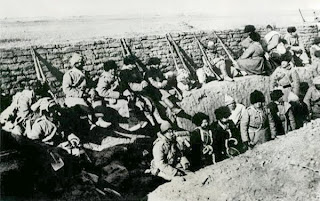
The dull reality was quite different from that dream. The Japanese had no desire for war and would willingly have settled the matter through negotiation but as Russian troops continued to move through the region, they had no alternative but to take up arms. In January 1904, they struck the first blow, attacking the Russian fleet at Port Arthur and, with self-righteous indignation, the Russians declared war. A tide of patriotic fervour swept the country and crowds gathered to cheer the troops setting out on their long journey east.
Although already in the later stages of her final pregnancy, Alix threw herself wholeheartedly into the war effort. She opened a hospital at Tsarskoe Selo where she paid daily visits to the wounded and arranged for the men to learn various crafts during their recuperation.
“The great salons of the Winter Palace were turned into workrooms and there every day society flocked to sew and knit for our soldiers and sailors fighting such incredible distances away, as well as for the wounded in hospitals at home and abroad…Every day the Empress came to inspect the work, often sitting down at a table and sewing diligently with the others.”
In the Kremlin, her sister, Ella also established workrooms and employed hundreds of women of all classes to arrange packages of icons and gifts to send to the Front. As the wounded returned to the city, she made daily visits to the military hospitals taking the time to talk to each man in turn.
“There is no end of work to be done,” wrote the Tsarina, “but it is a great comfort to be able to help one’s poor sufferers a little…All work hard…We work for the army hospitals (apart from the Red Cross) and for the well who need clothes, tobacco ... and then we furnish military trains...I like following all and not to be a mere doll. Yes, it is a trying time, but one must put all one’s trust in God, who gives strength and courage.”
The Tsarina’s sincere efforts made little impression on the vast majority of her people and as the lists of Russian casualties grew, the enthusiastic cheers turned to cries of anger. Far from being a weak little enemy, the Japanese were well-disciplined, efficient soldiers capable of inflicting terrible losses on the massive Russian army. The ‘short’ war was rapidly turning into a prolonged fiasco.
By autumn, after nine months of fighting, the disillusioned Russians had grown weary of sacrificing their sons in the hopeless campaign. Disturbances broke out in the streets of Moscow and St. Petersburg and the reactionary Minister of the Interior was assassinated. Strikes threatened to bring St. Petersburg to a standstill and the unrest was in danger of spilling into greater violence.
“Revolution is banging on the door,” wrote the Tsar’s cousin, Konstantin Konstantinovich, “A constitution is being almost openly discussed. How shameful and how terrifying.”
For Nicholas and Alix, the suggestion that Tsar should hand over his authority to an elected council (the Duma) was unthinkable. At his Coronation, Nicholas had taken an oath to uphold the autocracy and, regardless of the personal cost, he felt duty-bound by the promise made before God. From the seclusion of Tsarskoe Selo, Alix urged her husband to be strong, dismissing the ministers’ reports of imminent revolution as scare-mongering and assuring him that the ordinary Russians loved their Emperor.
It was true that many thousands of his subjects still revered their Tsar. He was their ‘Little Father’ who loved his people and only permitted the injustices they endured because he was unaware of their sufferings. If they could only reach him and tell him of their plight, he would surely deal kindly with their grievances. Encouraging such thoughts was a socialist priest, Father Gapon, who, in an attempt to prevent bloodshed, offered to lead a peaceful procession to the Winter Palace so that the people could petition the Emperor.
On Saturday 21st January 1905, Gapon, unaware that the Tsar was several miles away in Tsarskoe Selo, informed the Minister of the Interior, Prince Mirsky, that the following day he would lead over one hundred thousand people to the palace. At the thought of so vast a crown, Mirsky panicked. He warned the Tsar that violence may erupt and advised him to stay out of the city, before summoning mounted troops to guard the bridges over the frozen River Neva to prevent the crowds from reaching the palace.
The next day, Sunday 22nd January, thousands of men, women and children walked peacefully through the streets of St. Petersburg with the sole intention of presenting Nicky with their petitions. As the orderly procession neared the Neva bridges, many of the marchers held aloft icons and portraits of the Tsar and Tsarina to demonstrate their fidelity to the Orthodox Church and trust in their ‘Little Father.’
With absolute faith in their anointed Emperor, the crowds ignored the soldiers’ warnings to turn back and as the vast horde continued to advance, the terrified generals ordered the troops to open fire. Within minutes over a thousand of the Tsar’s most devoted subjects were gunned down, dropping their bloodstained icons beside the corpses of little children.
As news of the massacre spread through the country, Moscow exploded in violence. The city had long been a hot bed of sedition and now, as outraged revolutionaries incited the ordinary citizens to take up arms against ‘Bloody Nicholas the Butcher,’ barricades rose in the streets. The entire Romanov family became a symbol of oppression and tyranny and the most obvious target for the revolutionaries’ anger was Ella’s much-maligned husband, Grand Duke Serge.

The one member of the Imperial family to escape the revolutionary wrath was Ella. Before the outbreak of war, her charitable works had earned her a saintly reputation and once the hostilities started, her popularity soared. Even as the barricades rose in the streets, she ignored the police warnings, to make her daily round of the hospital wards. But Ella was not blind to the dangers. Serge had received several death threats while she herself was sent anonymous letters warning her, for her own safety, not to appear with her husband in public.
The strain of such an existence was enormous, and a final blow to reactionary Serge was the realisation that the Tsar was planning to grant limited reforms. Unable to accept the changes and worn down by the stress of his position, Serge finally decided to tender his resignation as Governor General of Moscow.
In the early afternoon February 18th 1905, as her husband left the Kremlin for the Governor General’s residence to clear his papers, Ella was working on her Red Cross projects, when an explosion shattered the silence.
“It’s Serge!” Ella cried, and rushing from the palace summoned a sleigh to speed her to the scene. As she approached Senate Square the gathering crowd tried to hold her back, but it was too late. Before her in the snow lay a tangled mess of flesh and bone - all that was left of her husband. His head, his leg and his arm had been blown off by a terrorist’s bomb. The blast was so great that, days later, his fingers were found on the roof of the Kremlin.
Scrambling through the gore for Serge’s medals and icons, Ella called to the soldiers for a stretcher from one of her Red Cross ambulances, then, with her own hands, placed what was left of her husband on the palette, which she ordered to be covered with soldiers’ coats and taken to a neighbouring monastery. A silent crowd followed her into the chapel where the stretcher was laid on the altar steps while she knelt and prayed.
“Drops of blood fell on the floor, slowly forming a dark pool,” wrote Serge’s niece, Maria Pavlovna. “My aunt was on her knees beside the litter, her bright dress shone forth grotesquely amid the humble garments surrounding her…
…Her face was white, her features terrible in their stricken rigidity. She did not weep…When she perceived us she stretched out her arms to us. We ran to her.
‘He loved you so, he loved you so,’ she repeated endlessly, pressing our heads against her. I noticed that, low on her right arm, the sleeve of her gay blue dress was stained with blood. There was blood on her hand, too, and under the nails of her fingers in which she tightly gripped [Serge’s] medals…”
That evening, though barely recovered from the shock, Ella summoned a carriage to take her to the hospital where Serge’s coachman lay fatally wounded. To avoid causing him further distress, the doctors had told him that his master was only slightly injured, and as Ella neared his bed, he asked for news of the Grand Duke.
She smiled gently, “It was he who sent me to you.”
That night the coachman, passed away in his sleep.

Fearful of further assassinations, the Tsar issued an order forbidding the Imperial family to travel to Moscow for the funeral. Victoria hurried to Russia to be at her sister’s side, and Serge’s sister, Marie, arrived from Coburg with Ella’s young cousin, ‘Baby Bee.’ Constrained in Tsarskoe Selo, Alix could only take comfort from the news that Ella was ‘bearing her terrible grief like a saint.’
Two days later Ella revealed the depths of her sanctity. Carrying a Bible and an icon of Christ, she set out for the prison where her husband’s killer, Ivan Kalyaev, was being held. In a private meeting, she wept as she told him that she had forgiven him and, without least hint of malice or anger, asked what had driven him to commit such a crime. Touched as he was by her sorrow and evident sincerity, Kalyaev had to tell her that he felt no remorse and believed his actions had been entirely justified. As she rose to leave, she told him, “I will pray for you,” and handed him the icon and Bible.
“I will not conceal,” he wrote to his friends, “that we looked at each other with a kind of mystical feeling.”
Newspapers later reported that she had even petitioned the Tsar for a pardon but, since the assassin failed to repent, her request was refused.

Kalyaev’s execution did nothing to still the tide of revolution sweeping through Russia and by August it was clear that there was no point in prolonging the disastrous Japanese War. In the humiliation of defeat, Alix continued her work for the wounded soldiers, organizing schemes to teach the disabled men new trades and providing them and their families with new cottages. But again her efforts passed largely unnoticed and the violence continued unabated. In the Caucasus, rebels attacked and murdered officials, and in Moscow, angry mobs manned barricades in the streets until Nicky realized he had no alternative but to call a Duma, effectively signing away the three-hundred-year-old autocracy.
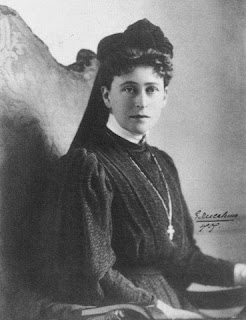
With the opening of the Duma in October 1905, a semblance of peace was restored. The barricades were dismantled, the strikers returned to work and the revolutionary fervour cooled but the Tsar’s reputation had suffered a blow from which it would never fully recover. While Alix was disgusted at the manner in which he had been forced to accept the Duma, revolutionaries were disappointed that the reforms had not gone far enough. Ella, meanwhile, mourning the loss of a husband she had deeply loved, was about to make a more revolutionary change in her life, than even the most committed Bolsheviks could have imagined.

A brilliant new book!


Before continuing with “Queen Victoria’s Granddaughters”, today I received word of the imminent availability of a new book which is going to be wonderful. No matter how many biographies appear, nothing ever quite compares to the feeling that comes with reading the actual letters exchanged between people. Queen Victoria’s letters to her daughter are far more interesting than any biography, as are the original letters of any other historical person. This book is entirely new as these letters have not been seen before. The book is: The Correspondence of the Empress Alexandra of Russia with Ernst Ludwig and Eleonore, Grand Duke and Duchess of Hesse. 1878-1916 collected, edited and compiled by Petra H. Kleinpenning. Below is a description of the book, which will soon be available on Amazon:

“As young people, Princess Alix of Hesse and by Rhine (1872-1918) and her brother, Hereditary Grand Duke Ernst Ludwig of Hesse and by Rhine (1868-1937), were always together. They remained on close terms when Alix married Tsar Nicholas II of Russia and became the Empress Alexandra Feodorovna. This book presents the complete collection of letters and postcards, written in English and German, that Alix wrote to her brother over the years 1878-1916, from moving children's notes to poignant letters written during the cataclysm of World War I. Also included are Alix's letters to Ernst Ludwig's second wife, Grand Duchess Eleonore, some letters from Tsar Nicholas II to Ernst Ludwig, and the few letters and postcards from Ernst Ludwig and Eleonore to the imperial couple that survived the days of the Russian Revolution of 1917. Alix's letters to Ernst Ludwig and Eleonore focus on the weal and woe of her family and friends, on official receptions and military manoeuvres, the concerts and performances she attended, her charities and her war work. This unique private correspondence between Alix and Ernst Ludwig and Eleonore provides additional first-hand details about the everyday lives of these important people in the history of Russia and Hesse and increases our understanding of their characters, interests, and relationships.”

http://www.bod.de/index.php?id=1132&objk_id=405799
I can’t wait to read it!

The Loveliest Stories of Love

As St. Valentine's day is nearly upon us, here are just a few of the great romances of the royalties of the recent past.

Queen Victoria and Prince Albert had, undoubtedly, one of the most romantic marriages! She adored him from the moment he arrived in England and, in spite of her youthful petulance, came to appreciate his many, many talents. It was a stormy and passionate relationship - at first, at least! - but in time, the Queen mellowed and learned to appreciate the lovely nobility and brilliance of this most remarkable prince. They sent each other erotic paintings and statues; they shared a deep love of their family and, with Albert, Queen Victoria was anything but the dull prude who appears through the dour statues in most of our cities. Prince Albert's tragic death at only forty-two led to her years in seclusion and the notions of her being a prude but they remain together forever in the British psyche in such things as the "V & A Museum", their memorials and the countless places named after them.


Vicky, Queen Victoria's eldest daughter, married at such an early age, a man whom she adored and who was equally enamored of her. Vicky and Fritz were totally devoted to one another and their tragedy was, yet again, that Fritz died far too soon! Had he lived, the whole course of European history might have been very different.


Franz Ferdinand and Sophie - a doomed love! A mere lady-in-waiting, Sophie was deemed unworthy of a Habsburg Archduke and heir to the throne but Franz Ferdinand was willing to sacrifice everything for her. A man who was seen as hot-tempered and unlikeable, he was devoted to his family and adored his wife. He wrote that the most sensible thing he ever did was to marry the woman he loved. It is a tragedy that they were both murdered on one of their first public appearances together (on their 14th wedding anniversary) but on the other hand, it seems fitting they they left this life side-by-side.


And, of course, another devoted couple who were murdered together - Alix and Nicholas. It is unthinkable that they could have left this world separately. Theirs was a marriage of two souls in harmony and, despite the many tragedies of their life in Russia, nothing ever shook, and nothing will ever shake, their devotion to one another.

Happy St. Valentine's Day!

Princess Alice of Hesse


Princess Alice, the second daughter of Queen Victoria, was open-minded and interested in intellectual pursuits like her sister Vicky. She was an interesting woman. Unfortunately, she had a very sad life.

The Princess was only a teenager when her beloved father died. She was very close to Prince Albert and nursed him a lot during his illness. She played the piano to him and read to him. When the grief overcame her she quietly left the room and came back when she had calmed down. "Her fortitude amazed their doctors and servants."

After the Prince died the poor Princess then had to take over many of Queen Victoria's duties and try and nurse her through her terrible grief. This proved impossible but the Princess was a great help to her.

Princess Alice's wedding to Prince Louis of Hesse, soon after her father's death, was more like a wedding than a funeral. Almost everyone dressed in black and spent the ceremony crying. Even the Archbishop who married the couple cried.

The Princess joined her husband in Darmstadt. Her marriage was not happy because Prince Louis liked military parades and shooting, instead of reading and cultural pursuits. He hardly ever read a book. Princess Alice was quite disappointed in him.

In spite of this, they had five children in quick succession. The children included Princess Alexandra, who became the tragic Tsarina, and beautiful Grand Duchess Ella, who was also killed by the Bolsheviks in a terrible way. Princess Alexandra's son, Alexai, inherited his haemophilia from his mother. Her brother, Fritti, was a haemophiliac. Princess Alice was distraught when the young boy fell out of the window and died shortly afterwards. She never really recovered from her grief.

The Princess devoted herself to charity work. Soon after her marriage there was a war between Austria and Prussia. Hesse was on the side of Austria which made Princess Alice and Vicki enemies. Princess Alice admired Florence Nightingale and nursed the sick and wounded with great devotion. After the war she continued her interest in charity work. She founded a mental asylum and worked for many charities, and established schools and hospitals.

She caused controversy when she became interested in a controversial theologian, David Strauss. He believed in the historical aspects of Jesus's life, but not the 'supernatural' aspects. Princess Vicky invited him to the palace and liked to discuss Christianity with him. Many Germans didn't like this, and the Empress Augusta even accused her of being an atheist.

Princess Alice was sickly. She suffered from severe headaches, neuralgia, and rheumatism. She wore herself out with her charity work. After her little daughter May died of diptheria, Alice soon caught it from her son, Ernest, who also had the illness. She died at only 35 on the anniversary of her father's death.

Queen Victoria wrote that 'the princess who behaved so admirably during her dear father's illness...should be called back on this very anniversary, seems almost incredible, and most mysterious.'

Princess Alice was greatly beloved in Germany and England because of her charity work. The Princess Alice hospital in Eastbourne was opened in her memory in 1883.

Grigory Rasputin


On this day (or yesterday if he died before Midnight) according to the Old Russian calendar, 93 years ago, Grigory Rasputin was murdered in a madcap plan to save the Romanov dynasty. To this day the exact details of his death remain sketchy and Prince Felix Youssoupov's claims to have fired the fatal bullet seem somewhat far-fetched. Nevertheless, the man was killed in vain. It was too late to save the dynasty and it was probably too late for Rasputin to claim to have any influence in anything that was going on in Russia. Events were moving too quickly and Rasputin had already gone beyond his capacity to be of any assistance to anyone.

These are only my thoughts about him and they might be mistaken. Rasputin, to my mind, was a simple peasant with a remarkable gift. He cannot be dismissed as simply a charlatan because the Tsarina Alexandra was far too astute and spiritual a being to be conned by someone so superficial. The driving force behind the Tsarina was the natural desire to end her son's suffering and her sense of responsibility in supporting her husband, Tsar Nicholas, and ensuring that he was able to adhere to his Coronation Oath and maintain the stability of the country. Alexandra was first and foremost a wife and mother. She had no personal desire for power but she had married - out of love - one of the most significant players on the world stage: the Tsar of all the Russias, who, likewise, had no personal desire for power, only the sense of having to carry that burden to the best of his ability. As any loving wife would do, she supported her husband in his work. Their only son suffered from haemophilia - a condition which, at the time, meant the slightest knock could leave him in excruciating pain and even prove fatal. Moreover, that beautiful child, was being groomed to one day rule the mighty Russian Empire and Alexandra's role was so ensure that he was capable of so doing, but the poor boy was often laid low by his illness and, like any mother, Alexandra would have done anything to ease his pain.

Into this scenario stepped the rough peasant Rasputin with his mystical gifts of being able to alleviate suffering. He was certainly successful on one level and he was also able to give Alexandra the hope and support she craved. Naturally, he appeared to her as a holy 'Man of God' - and perhaps he was, in the beginning. Alexei (the Tsarevich) felt better when Rasputin assured Alexandra that all was well. Nowadays, when so much information is available about the power of the mind, such things make a lot of sense, but then it was simply 'miraculous'. Unfortunately, I think, Rasputin came to associate himself with his own power and, becoming arrogant in his complacency, completely lost sight of his gifts. He began interfering and, like a petulant child, became angry when he wasn't appreciated, and his anger was often followed by deep remorse. He was simply 'too big for his own boots'. He couldn't cope with his gifts and they began to fail him. There was no way he could have averted the war (interesting, considering the power of the mind, that he absented himself at the time its outbreak, by drawing to himself (unconsciously) an attack from a fanatical opponent); nor could he have prevented the Russian Revolution and he made his convenient escape by opening himself to being murdered only months before it all fell apart.

The truly mystical part of Rasputin is, to my mind, his way of thinking. A gifted man who could have done so much good, but he became so self-absorbed and incapable of using his gifts wisely that it led only to disaster for him and for a dynasty. I was taught in school that Rasputin was a major factor in sparking the revolution. I don't think that is true. I think he was merely an excuse, among many other excuses, for leading Russia into the chaos that followed. Alexandra and her children respected him and, for that reason alone, I think he needs to be remembered tonight.

Original Letters


While reading a translation of some of the diaries of a member of the Russian Imperial Family, recently, I came across a statement by the translator which said something to the effect of, "The rest of the diaries are more of the same - incidental and uninteresting details about everyday life." I was horrified by the word 'uninteresting' because the incidental details were far more fascinating than widely published major events.

Some editors of letters seem quite cold with respect to the authors of the letters. Perhaps these are privileged people who are blessed to have access to some archives but don't really care for the person about whom they are writing. I have read a couple of books where the editor's notes intrude on the letters themselves and make snap judgements about what was going on (rather reminds me of a line from T.S. Eliot's poem "and that isn't what I meant at all..."). On the other hand, I adore Roger Fulford's collections of the letters between Vicky (Empress Frederick of Germany) and her mother, Queen Victoria, because the editor includes notes at the beginning but makes none of those horrid intrusions. "A Lifelong Passion" - the letters and diaries of various members of the Imperial Family - is equally beautiful! (These are the books which - along with "Le Petit Prince" by Antoine de St. Exupery and "Science of Mind" by Ernest Holmes" - that I would take to a desert island if I knew I were to be stranded for some time!).

I have just heard of what must be a wonderful collection of letters between Alix, the last Tsarina of Russia and her long-time friend, Toni Becker. Since this collection is compiled by Toni's granddaughter, Lotte Hoffmann-Kuhnt, it is sure to be written with deep respect and love and none of the intrusion. This will surely be priceless treasure to anyone interested in the Romanovs and who cares about the truth beyond the fiction!

http://www.bod.de/index.php?id=1132&objk_id=209980
http://www.amazon.de/
Related Posts Plugin for WordPress, Blogger...