"The Last Link Is Cut Off" - More of Queen Victoria's Granddaughters
At the beginning of July 1897, Vicky returned from the Jubilee celebrations to her beloved Friedrichshof. There, between visits from her daughters and frequent trips to her beloved Italy, she continued to amass her artistic collections with the same enthusiasm she had shown as a child when collecting fossils to add to her collection in the Swiss Cottage. Friedrichshof was so full of antiques and treasures that, according to a regular visitor, Marie Louise, the ‘wonderful’ place became:
“..more of a museum than a house…I remember once…I went upstairs to my room and lay down on my sofa. My aunt came to see that I had everything I needed and seeing me reclining on the couch said: ‘Dear child do you not know that you are lying on a cinquecento coverlet!’ and she placed a newspaper over it although I had already taken the precaution of removing my shoes.”
Vicky’s concern for her antiques, however, did not prevent her from welcoming children into her home, and one of the chief delights of her widowhood was the pleasure she took in her grandchildren. It saddened her deeply that Willy’s wife seemed so intent on alienating her from their six sons and had acerbically pointed out that the choice of the name Victoria for their only daughter was not made out of deference to her grandmother. But while one daughter-in-law exacerbated the antagonism between Vicky and her son, her second daughter-in-law, Irène of Hesse, proved far more accommodating.
Since Irène’s marriage to Henry, in May 1888, the mutual and long-standing affection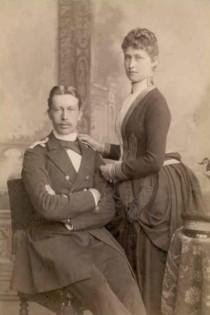
between aunt and niece had deepened, not least because Irène had done so much to improve relations between Vicky and Henry. Life with the Kaiser’s volatile brother was not always easy for the Hessian princess:
“[He] was a tall and handsome man, but inclined to be - let us say - temperamental. At times he was overbearing and very satirical, and at others friendly and charming. His wife was a small woman, simple in manner and of a kindly, unselfish nature.”
Notwithstanding her docility, Irène succeeded in calming his fiery temper and by the time of the Diamond Jubilee, Queen Victoria’s lady-in-waiting, Marie Mallet thought him ‘simple friendly and courteous…the nicest male royalty going.’
The couple had settled in the Königliches Schloss in Kiel from where Henry continued his naval duties and indulged his passion for motor cars and engines, and to where, in March 1889, Vicky and Moretta had hurried to assist Irène through the birth of her first child.
Suffering none of Queen Victoria’s revulsion about the ‘unecstatic and animal’ state of pregnancy, Vicky set to work preparing the nursery and layette for the baby. Though the welcome she received was cordial and her efforts were greatly appreciated, she could not help but feel disappointed to find so few books in the house. It seemed incongruous that the well-educated daughter of Princess Alice showed so little interest in world events and was unable to discuss matters of political importance. Vicky may well have agreed, too, with Marie Mallet’s view that Irène’s ladies-in-waiting were ‘very dull and by no means easy to get on with.’
But if Vicky wanted reassuring that this truly was Alice’s daughter, she needed only to recall how easily her sister had shocked the Queen by breast-feeding her baby. Now it was Vicky’s turn to be appalled when Irène made no attempt to hide her pregnancy behind shawls and rugs, but appeared quite openly in public right up to the time of the birth.
“I think it quite embarrassing,” Vicky wrote prudishly to the Queen, “and would never have dreamed of doing so especially before gentlemen and children and strangers.”
Embarrassed or not, she remained at Irène’s side through the ‘quick, easy’ birth of a son, Waldemar, on 20th March 1889. The baby’s healthy appearance belied a terrible truth. It soon became clear that Waldemar was a haemophiliac, which perhaps accounts for the seven-year gap before Irène gave birth to a second child, Sigismund. Four years later the family was completed with the birth of a third son, Henry.
“I wonder that you are pleased at Irène’s having a third boy.” Queen Victoria wrote to Vicky, “There are far too many princes in Prussia.”
There was an unfortunate irony in the remark, for even as Irène was hoping for a daughter, her younger sister, Alix, Tsarina of Russia, was still desperately praying for a son.
Boys or girls, Vicky delighted in her grandchildren and looked forward with pleasure to Sophie’s frequent visits to Friedrichshof with her large family or the arrival of Mossy and Fischy with their twins. Between and during their stays she continued to enjoy the beautiful scenery of Krönberg walking and riding daily as she had done since childhood, until an accident brought her outings to a sad conclusion.
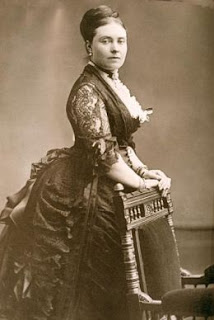
In September 1898, while out riding with Mossy, Vicky’s horse ‘took fright at a steam threshing machine…and shied violently.’ Vicky was thrown from the saddle but, though bruised and badly shaken, was able to write the next day to her mother that:
“I got up and walked part of the way home and only felt shaken and stiff towards evening…I am alright today except for a headache.”
In reality, Vicky was far more ill than anyone realised. Throughout her life, she had been troubled by a myriad of rheumatic ailments but following the accident she suffered severe back pain, which intensified with the passing of time. After consulting several doctors who presented conflicting medical opinions, she was eventually diagnosed with breast cancer, which had spread to her spine. Determined to continue living life to the full, she kept the news from her family, referring to her pain simply as lumbago and confiding the truth only to her youngest sister, Beatrice, and their mother.
For several months, she was able to make her regular excursion to Italy and France until, by the end of 1899, the pain left her confined to bed for long periods and she had no alternative but to reveal the truth to her daughters. Charlotte was the last to be told and though she, like the others, promised to keep the news to herself, she immediately announced her mother’s illness to the world.
Mossy, Moretta, and Irène were on hand to offer what comfort they could and Sophie hurried from Greece to be at her mother’s side. Vicky endured her sufferings with fortitude and a touching concern for others, apologising to her nurses for upsetting them by her screams. Yet, hard as she tried to maintain a positive outlook, the pain, relieved only by minimal amounts of morphine, was excruciating and, at its height, she refused to see anyone for fear of causing them distress:
“My legs are shrunken and falling away to nothing, a mere skeleton,” she wrote to Sophie, “The agony is as bad as ever, the nights are a torture…The tears and groans all night long drive me utterly mad. I often think I should put an end to myself if only I could. Oh I cannot bear it any longer!”
So loud were her cries of agony that even the soldiers guarding her palace requested permission to move out of earshot.
For Queen Victoria, her eldest daughter’s illness was but one in a series of heartaches that marred her last years. In the closing years of the century, she mourned not only for Liko, for Young Affie and the Duke of Edinburgh and Coburg, but as the mother of her country, she grieved too for the young officers dying by the dozen in the South African War. Her concern for the soldiers was genuine and she repeatedly sent telegrams assuring them of her gratitude whether in victory or defeat. Though the Queen never doubted the justice of the British cause, the conflict bore an ominous portent of the division that a future war would wreak in the family.
Vicky and her three younger daughters supported the British and shared the Queen’s concern for her troops. From Sophie in Athens, from Vicky in the Friedrichshof and from Mossy in Hesse-Kassel, parcels arrived for the English soldiers, while the princesses studied British newspapers for reports of the cruelty and treachery of the Boers.
Across much of the rest of Europe, however, a different story was told. In Russia, Alix and Ella read reports of the British atrocities and the claim that their grandmother’s soldiers were using Boer women and children as shields.
“We…are right behind the Boers and wish them every success in the war,” wrote the Tsar’s sister. “I think there can be no one (except the English) who isn’t on their side!”
Even Tsar Nicholas, who claimed to discuss the matter every day at dinner, agreed with his sister, leaving Alix torn between loyalty to her grandmother and her husband.
“She is, of course appalled at the loss of English officers,” Nicky wrote, “but what can you do, it has always been like that in their wars!”
From Prussia, too, the Kaiser - while pompously offering his grandmother advice on how best to proceed - praised the Boers’ successes. In Germany ‘the antagonistic feeling…against England was very pronounced,’ making life especially difficult for those English princesses, Marie Louise of Schleswig-Holstein and Alice of Albany, who were living in there. Alice’s brother, as a German officer cadet had no option but to support the Kaiser’s view, while for Marie Louise, who had one brother, Albert, in the German army and another, Christle, serving with the English forces, the situation was still direr.
Christle, a Captain in the King’s Own Rifle Corps, had heroically come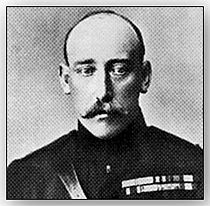
through ‘many hardships’ in the campaign until, like his Uncle Liko before him, he contracted malaria and enteric fever. His sisters, anxiously awaiting news at Balmoral, heard that he was being well treated in the military hospital in Pretoria, but within days pneumonia had set in and he died on 29th October 1900. At his own request his body was buried alongside his fellow officers in Pretoria.
“Dear unselfish Princess Thora [is] just heart broken,” wrote Marie Mallet, “she cared more for her brother than for anything on earth and was justly proud of his valour…[She] is admirable, although she and her mother will miss him every hour of every day…she thinks of everyone but herself.”
It was left to the heart-broken Thora to take the news of the death of yet another grandson to the Queen.
“I cannot write but a few words, as we are in such distress about dear beloved Christle’s loss.” The Queen told Vicky, “…Poor dear Lenchen bears up wonderfully; so too does poor dear Thora…”
Even as she wrote the letter, Queen Victoria was filled with anxiety for the future of its recipient, for by then she knew that Vicky herself was dying.
The series of bereavements, Marie Louise’s divorce, anxieties about Vicky and the stress of the war brought about a rapid deterioration in Queen Victoria’s health.
“She said,” wrote Marie Mallet in the summer of 1900, “that the trials and sorrows of the last few months were almost more than she could bear and, alas, I cannot help feeling that there may be more in store.”
Her sight was failing and, scarcely able to walk any distance, she spent much of her time in the company of her granddaughter, Thora, who patiently sat at her side, listening even as her mind began to fail and she rambled occasionally incoherently of events of the past.
Shortly before Christmas 1900, Queen Victoria left Windsor for the last time, setting sail for her beloved Osborne House on the Isle of Wight. It was a cold, bleak winter and, the frail Queen was visibly fading.
“My sight is rather bad since I have been poorly,” she wrote to Vicky on 6th January, “but I hope it will soon be much better.”
It was not to be. Within a fortnight, telegrams were flying across the continent warning of her decline. Princesses hurried to the island to take their turn in approaching Grandmama’s bed to whisper a last good-bye. Racing, too, across the Solent, much to his aunts’ distress was the Queen’s eldest grandson, Kaiser Wilhelm II, who genuinely wished to see her for one last time.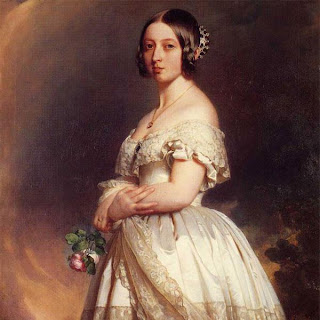 Throughout the 22nd January the Queen lapsed in and out of consciousness and shortly before noon she seemed so close to death that the royalties were summoned to her bedside. As her chaplain, Dr. Davison began his prayers the Queen was able to recognise the members of her family: Victoria Battenberg, who was staying on the Royal Yacht Osborne; the Dowager Duchess of Coburg and her little grandchild, Ducky’s daughter, Elizabeth of Hesse. Daisy and Patsy Connaught arrived with their parents and joined the Prince of Wales and the Queen’s younger daughters, Lenchen, Louise and Beatrice in their vigil. For a few hours she rallied and the family withdrew but by mid-afternoon she had suffered a relapse. At half-past six in the evening of 22nd January 1901, Queen Victoria, died in the Kaiser’s arms.
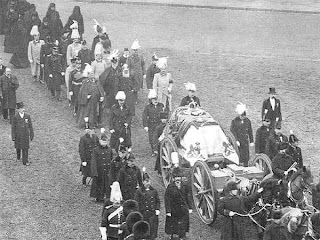
Ten days later, a long procession of royal mourners followed the coffin towards the yacht Alberta that was to take the Queen’s body back to England. On 4th February, through flurries of snow, the cortege set out from the Albert Memorial Chapel in Windsor to Queen Victoria’s final resting place beside beloved Albert in the Mausoleum at Frogmore. For Marie Louise, standing beside the coffin brought a deep sense of ‘peace and awe’, but, in typical Wales’ fashion, her cousin, Maud, confessed that she found the funeral procession to ‘rather trying & exhausting.’
“I cannot believe that she is really gone, that we shall never see her anymore. It seems impossible,” wept the young Tsarina Alix, whose fourth pregnancy had prevented her from making the journey to England. “How I envy you [she wrote to her sister, Victoria] being able to see beloved Grandmama being taken to her last rest.” A memorial service was held for the Queen in St. Petersburg where, for the first time since her arrival in Russia, the Tsarina wept in public.
While Ducky avoided the funeral, remaining in France with her Russian lover, her elder sister, Missy, was deeply distressed at being prevented from accompanying her husband to the ceremonies. She sensed the implications of the loss of ‘dearest grandmama’ and in a letter to her mother described her longing to return to England:
“To see it all again if only for a day or two…to have a last peep at the old house…with out dear old Granny the last link is cut off!...I tell you it is inconceivable sorrow for me.”
For Alice Albany, who had returned from Germany for the funeral it was an equally devastating experience:
“I had come to regard her as permanent and indestructible - like England and Windsor Castle.”
But it was the future Queen Mary who, perhaps, most accurately expressed the country’s sense of bewilderment:
“The thought of England without the Queen is dreadful even to think of. God help us all.”
Grief-stricken at the death of her grandmother, Mossy of Prussia faced the most difficult task of all. It fell to her to break the news to her mother. Vicky heartbroken and racked with pain, wept “I wish I were dead too!”
For six more months, she struggled on, her agony increasing by the day. In February 1901, she received a final visit from her brother, the new King Edward VII. In spite of the friction between Willy and ‘Uncle Bertie’, the encounter passed off amiably enough, thanks largely to the tact of Sophie and Mossy who ‘were always ready to dash in if the conversation seemed to get into dangerous channels.’ Bertie was horrified by his sister’s rapid deterioration; as she sat ‘propped up with cushions; she looked as if she had just been taken off the rack after undergoing torture.’ Before they left, the king’s physician Sir Francis Laking persuaded her doctors to administer larger doses of morphine to combat her pain.
Through the last few months of her life, Vicky’s daughters and daughter-in-law, Irène, visited regularly, Mossy and Moretta barely leaving her side. To the end she continued to take an interest in current events and in her daughters’ futures; when Sophie arrived from Greece, Vicky urged her to continue to care for the poor of her country. To the last, too, Vicky remained first and foremost an English princess. To her friend Bishop Boyd-Carpenter, she confided that she hoped he would preside at her funeral and read the English Burial Service over her.
In the early evening of August 5th 1901, Vicky, surrounded by her children, died reciting the Lord’s Prayer. The funeral service she had requested was carried out at the English Church Homburg, to be followed some days later by a Lutheran funeral at Krönberg, after which she was interred with Fritz at Potsdam. In her will she left her favourite home at Friedrichshof to her youngest daughter, Mossy.
The death of Queen Victoria severed the tie uniting the royal cousins. Without her as their mainstay, there would be no common bond to keep the family together. With the dawning of the new century, the old world had passed away and the ominous clouds across the Solent portended a future far bleaker for the family that anyone could have predicted.
“..more of a museum than a house…I remember once…I went upstairs to my room and lay down on my sofa. My aunt came to see that I had everything I needed and seeing me reclining on the couch said: ‘Dear child do you not know that you are lying on a cinquecento coverlet!’ and she placed a newspaper over it although I had already taken the precaution of removing my shoes.”
Vicky’s concern for her antiques, however, did not prevent her from welcoming children into her home, and one of the chief delights of her widowhood was the pleasure she took in her grandchildren. It saddened her deeply that Willy’s wife seemed so intent on alienating her from their six sons and had acerbically pointed out that the choice of the name Victoria for their only daughter was not made out of deference to her grandmother. But while one daughter-in-law exacerbated the antagonism between Vicky and her son, her second daughter-in-law, Irène of Hesse, proved far more accommodating.
Since Irène’s marriage to Henry, in May 1888, the mutual and long-standing affection

between aunt and niece had deepened, not least because Irène had done so much to improve relations between Vicky and Henry. Life with the Kaiser’s volatile brother was not always easy for the Hessian princess:
“[He] was a tall and handsome man, but inclined to be - let us say - temperamental. At times he was overbearing and very satirical, and at others friendly and charming. His wife was a small woman, simple in manner and of a kindly, unselfish nature.”
Notwithstanding her docility, Irène succeeded in calming his fiery temper and by the time of the Diamond Jubilee, Queen Victoria’s lady-in-waiting, Marie Mallet thought him ‘simple friendly and courteous…the nicest male royalty going.’
The couple had settled in the Königliches Schloss in Kiel from where Henry continued his naval duties and indulged his passion for motor cars and engines, and to where, in March 1889, Vicky and Moretta had hurried to assist Irène through the birth of her first child.
Suffering none of Queen Victoria’s revulsion about the ‘unecstatic and animal’ state of pregnancy, Vicky set to work preparing the nursery and layette for the baby. Though the welcome she received was cordial and her efforts were greatly appreciated, she could not help but feel disappointed to find so few books in the house. It seemed incongruous that the well-educated daughter of Princess Alice showed so little interest in world events and was unable to discuss matters of political importance. Vicky may well have agreed, too, with Marie Mallet’s view that Irène’s ladies-in-waiting were ‘very dull and by no means easy to get on with.’
But if Vicky wanted reassuring that this truly was Alice’s daughter, she needed only to recall how easily her sister had shocked the Queen by breast-feeding her baby. Now it was Vicky’s turn to be appalled when Irène made no attempt to hide her pregnancy behind shawls and rugs, but appeared quite openly in public right up to the time of the birth.
“I think it quite embarrassing,” Vicky wrote prudishly to the Queen, “and would never have dreamed of doing so especially before gentlemen and children and strangers.”
Embarrassed or not, she remained at Irène’s side through the ‘quick, easy’ birth of a son, Waldemar, on 20th March 1889. The baby’s healthy appearance belied a terrible truth. It soon became clear that Waldemar was a haemophiliac, which perhaps accounts for the seven-year gap before Irène gave birth to a second child, Sigismund. Four years later the family was completed with the birth of a third son, Henry.
“I wonder that you are pleased at Irène’s having a third boy.” Queen Victoria wrote to Vicky, “There are far too many princes in Prussia.”
There was an unfortunate irony in the remark, for even as Irène was hoping for a daughter, her younger sister, Alix, Tsarina of Russia, was still desperately praying for a son.
Boys or girls, Vicky delighted in her grandchildren and looked forward with pleasure to Sophie’s frequent visits to Friedrichshof with her large family or the arrival of Mossy and Fischy with their twins. Between and during their stays she continued to enjoy the beautiful scenery of Krönberg walking and riding daily as she had done since childhood, until an accident brought her outings to a sad conclusion.

In September 1898, while out riding with Mossy, Vicky’s horse ‘took fright at a steam threshing machine…and shied violently.’ Vicky was thrown from the saddle but, though bruised and badly shaken, was able to write the next day to her mother that:
“I got up and walked part of the way home and only felt shaken and stiff towards evening…I am alright today except for a headache.”
In reality, Vicky was far more ill than anyone realised. Throughout her life, she had been troubled by a myriad of rheumatic ailments but following the accident she suffered severe back pain, which intensified with the passing of time. After consulting several doctors who presented conflicting medical opinions, she was eventually diagnosed with breast cancer, which had spread to her spine. Determined to continue living life to the full, she kept the news from her family, referring to her pain simply as lumbago and confiding the truth only to her youngest sister, Beatrice, and their mother.
For several months, she was able to make her regular excursion to Italy and France until, by the end of 1899, the pain left her confined to bed for long periods and she had no alternative but to reveal the truth to her daughters. Charlotte was the last to be told and though she, like the others, promised to keep the news to herself, she immediately announced her mother’s illness to the world.
Mossy, Moretta, and Irène were on hand to offer what comfort they could and Sophie hurried from Greece to be at her mother’s side. Vicky endured her sufferings with fortitude and a touching concern for others, apologising to her nurses for upsetting them by her screams. Yet, hard as she tried to maintain a positive outlook, the pain, relieved only by minimal amounts of morphine, was excruciating and, at its height, she refused to see anyone for fear of causing them distress:
“My legs are shrunken and falling away to nothing, a mere skeleton,” she wrote to Sophie, “The agony is as bad as ever, the nights are a torture…The tears and groans all night long drive me utterly mad. I often think I should put an end to myself if only I could. Oh I cannot bear it any longer!”
So loud were her cries of agony that even the soldiers guarding her palace requested permission to move out of earshot.
For Queen Victoria, her eldest daughter’s illness was but one in a series of heartaches that marred her last years. In the closing years of the century, she mourned not only for Liko, for Young Affie and the Duke of Edinburgh and Coburg, but as the mother of her country, she grieved too for the young officers dying by the dozen in the South African War. Her concern for the soldiers was genuine and she repeatedly sent telegrams assuring them of her gratitude whether in victory or defeat. Though the Queen never doubted the justice of the British cause, the conflict bore an ominous portent of the division that a future war would wreak in the family.
Vicky and her three younger daughters supported the British and shared the Queen’s concern for her troops. From Sophie in Athens, from Vicky in the Friedrichshof and from Mossy in Hesse-Kassel, parcels arrived for the English soldiers, while the princesses studied British newspapers for reports of the cruelty and treachery of the Boers.
Across much of the rest of Europe, however, a different story was told. In Russia, Alix and Ella read reports of the British atrocities and the claim that their grandmother’s soldiers were using Boer women and children as shields.
“We…are right behind the Boers and wish them every success in the war,” wrote the Tsar’s sister. “I think there can be no one (except the English) who isn’t on their side!”
Even Tsar Nicholas, who claimed to discuss the matter every day at dinner, agreed with his sister, leaving Alix torn between loyalty to her grandmother and her husband.
“She is, of course appalled at the loss of English officers,” Nicky wrote, “but what can you do, it has always been like that in their wars!”
From Prussia, too, the Kaiser - while pompously offering his grandmother advice on how best to proceed - praised the Boers’ successes. In Germany ‘the antagonistic feeling…against England was very pronounced,’ making life especially difficult for those English princesses, Marie Louise of Schleswig-Holstein and Alice of Albany, who were living in there. Alice’s brother, as a German officer cadet had no option but to support the Kaiser’s view, while for Marie Louise, who had one brother, Albert, in the German army and another, Christle, serving with the English forces, the situation was still direr.
Christle, a Captain in the King’s Own Rifle Corps, had heroically come

through ‘many hardships’ in the campaign until, like his Uncle Liko before him, he contracted malaria and enteric fever. His sisters, anxiously awaiting news at Balmoral, heard that he was being well treated in the military hospital in Pretoria, but within days pneumonia had set in and he died on 29th October 1900. At his own request his body was buried alongside his fellow officers in Pretoria.
“Dear unselfish Princess Thora [is] just heart broken,” wrote Marie Mallet, “she cared more for her brother than for anything on earth and was justly proud of his valour…[She] is admirable, although she and her mother will miss him every hour of every day…she thinks of everyone but herself.”
It was left to the heart-broken Thora to take the news of the death of yet another grandson to the Queen.
“I cannot write but a few words, as we are in such distress about dear beloved Christle’s loss.” The Queen told Vicky, “…Poor dear Lenchen bears up wonderfully; so too does poor dear Thora…”
Even as she wrote the letter, Queen Victoria was filled with anxiety for the future of its recipient, for by then she knew that Vicky herself was dying.
The series of bereavements, Marie Louise’s divorce, anxieties about Vicky and the stress of the war brought about a rapid deterioration in Queen Victoria’s health.
“She said,” wrote Marie Mallet in the summer of 1900, “that the trials and sorrows of the last few months were almost more than she could bear and, alas, I cannot help feeling that there may be more in store.”
Her sight was failing and, scarcely able to walk any distance, she spent much of her time in the company of her granddaughter, Thora, who patiently sat at her side, listening even as her mind began to fail and she rambled occasionally incoherently of events of the past.
Shortly before Christmas 1900, Queen Victoria left Windsor for the last time, setting sail for her beloved Osborne House on the Isle of Wight. It was a cold, bleak winter and, the frail Queen was visibly fading.
“My sight is rather bad since I have been poorly,” she wrote to Vicky on 6th January, “but I hope it will soon be much better.”
It was not to be. Within a fortnight, telegrams were flying across the continent warning of her decline. Princesses hurried to the island to take their turn in approaching Grandmama’s bed to whisper a last good-bye. Racing, too, across the Solent, much to his aunts’ distress was the Queen’s eldest grandson, Kaiser Wilhelm II, who genuinely wished to see her for one last time.
 Throughout the 22nd January the Queen lapsed in and out of consciousness and shortly before noon she seemed so close to death that the royalties were summoned to her bedside. As her chaplain, Dr. Davison began his prayers the Queen was able to recognise the members of her family: Victoria Battenberg, who was staying on the Royal Yacht Osborne; the Dowager Duchess of Coburg and her little grandchild, Ducky’s daughter, Elizabeth of Hesse. Daisy and Patsy Connaught arrived with their parents and joined the Prince of Wales and the Queen’s younger daughters, Lenchen, Louise and Beatrice in their vigil. For a few hours she rallied and the family withdrew but by mid-afternoon she had suffered a relapse. At half-past six in the evening of 22nd January 1901, Queen Victoria, died in the Kaiser’s arms.
Ten days later, a long procession of royal mourners followed the coffin towards the yacht Alberta that was to take the Queen’s body back to England. On 4th February, through flurries of snow, the cortege set out from the Albert Memorial Chapel in Windsor to Queen Victoria’s final resting place beside beloved Albert in the Mausoleum at Frogmore. For Marie Louise, standing beside the coffin brought a deep sense of ‘peace and awe’, but, in typical Wales’ fashion, her cousin, Maud, confessed that she found the funeral procession to ‘rather trying & exhausting.’
“I cannot believe that she is really gone, that we shall never see her anymore. It seems impossible,” wept the young Tsarina Alix, whose fourth pregnancy had prevented her from making the journey to England. “How I envy you [she wrote to her sister, Victoria] being able to see beloved Grandmama being taken to her last rest.” A memorial service was held for the Queen in St. Petersburg where, for the first time since her arrival in Russia, the Tsarina wept in public.
While Ducky avoided the funeral, remaining in France with her Russian lover, her elder sister, Missy, was deeply distressed at being prevented from accompanying her husband to the ceremonies. She sensed the implications of the loss of ‘dearest grandmama’ and in a letter to her mother described her longing to return to England:
“To see it all again if only for a day or two…to have a last peep at the old house…with out dear old Granny the last link is cut off!...I tell you it is inconceivable sorrow for me.”
For Alice Albany, who had returned from Germany for the funeral it was an equally devastating experience:
“I had come to regard her as permanent and indestructible - like England and Windsor Castle.”
But it was the future Queen Mary who, perhaps, most accurately expressed the country’s sense of bewilderment:
“The thought of England without the Queen is dreadful even to think of. God help us all.”
Grief-stricken at the death of her grandmother, Mossy of Prussia faced the most difficult task of all. It fell to her to break the news to her mother. Vicky heartbroken and racked with pain, wept “I wish I were dead too!”
For six more months, she struggled on, her agony increasing by the day. In February 1901, she received a final visit from her brother, the new King Edward VII. In spite of the friction between Willy and ‘Uncle Bertie’, the encounter passed off amiably enough, thanks largely to the tact of Sophie and Mossy who ‘were always ready to dash in if the conversation seemed to get into dangerous channels.’ Bertie was horrified by his sister’s rapid deterioration; as she sat ‘propped up with cushions; she looked as if she had just been taken off the rack after undergoing torture.’ Before they left, the king’s physician Sir Francis Laking persuaded her doctors to administer larger doses of morphine to combat her pain.
Through the last few months of her life, Vicky’s daughters and daughter-in-law, Irène, visited regularly, Mossy and Moretta barely leaving her side. To the end she continued to take an interest in current events and in her daughters’ futures; when Sophie arrived from Greece, Vicky urged her to continue to care for the poor of her country. To the last, too, Vicky remained first and foremost an English princess. To her friend Bishop Boyd-Carpenter, she confided that she hoped he would preside at her funeral and read the English Burial Service over her.
In the early evening of August 5th 1901, Vicky, surrounded by her children, died reciting the Lord’s Prayer. The funeral service she had requested was carried out at the English Church Homburg, to be followed some days later by a Lutheran funeral at Krönberg, after which she was interred with Fritz at Potsdam. In her will she left her favourite home at Friedrichshof to her youngest daughter, Mossy.
The death of Queen Victoria severed the tie uniting the royal cousins. Without her as their mainstay, there would be no common bond to keep the family together. With the dawning of the new century, the old world had passed away and the ominous clouds across the Solent portended a future far bleaker for the family that anyone could have predicted.


