Showing posts with label Edward VII. Show all posts

The Making of a King


When their first son, Bertie, was born Queen Victoria and Prince Albert – both of whom were still so young – sought guidance about his upbringing from Prince Albert’s mentor Baron Stockmar. His advice couldn’t have been more detrimental to the poor Prince of Wales whose memories of childhood were so unhappy that as soon as he became King, he disposed of that great (and beautiful!) symbol of his childhood, Osborne House. As a boy Bertie could never please his parents. He just couldn’t fit their (or Stockmar’s) ideal of the perfect prince. Gauche, not studious or particularly academically intelligent, his natural talents for diplomacy and charm were so often overlooked. I adore Prince Albert and think that the one mistake of his life was his treatment – albeit well-intentioned – of the future King Edward VII. In later life, the perceived traumas of this strict regimen showed up in Bertie’s addictions to food, sex and gambling and anything else that brought him comfort. His life, however, was not a tragedy! He was well-liked, affable, had the common touch alongside great dignity and he was a great statesman and ambassador, though his reign was so brief.

Prince Albert and Queen Victoria wanted to raise the perfect prince.

Seeing the footage of Prince William in New Zealand today, I was over-awed by the thought that it took a few generations and far less strict regimen for that dream to
come into being. Prince William was amazing! One moment dressed in casual clothes, shaking hands with the crowds, crouching to have his photo taken with children, and chatting to them as freely as if they were old friends. When someone in the crowd called out, “I will see you in London on the 29th!” Prince William, with genuine delight replied, “You’re coming? You are all invited!!” The next minute, in a smart suit and a Maori ‘stole’ he was addressing the earthquake victims with a solemnity and wisdom that was so touching. He spoke of his grandmother and the advice she had given him – and who could fail to notice that he, having lost his mother at such a young age, understood grief - and his dignified references to Her Majesty also showed such respect for the Queen (as did the way he sang the National Anthem, ‘God Save the Queen’, with such gusto).

Kipling's wonderful lines immediately came to mind:

“If you can walk with crowds and keep your virtue,
Or walk with kings nor lose the common touch...”


If ever the British monarchy needed a lift when the scurrilous newspapers go in search of scandals, I am sure this young prince is the perfect person for the job. Not only would his mother be so proud of him, but also his great-great-great-great-grandparents, Prince Albert and Queen Victoria must surely be looking down at him and thinking, “Well, we got there in the end!”

"Poor Girl, She is Utterly Miserable Now" - More of Queen Victoria's Granddaughters

The summer 1902 saw London bustling with preparations for the coronation of King Edward VII. So many years had passed since Queen Victoria’s accession that even the most aged courtiers had no recollection of the protocol of such ceremonies but for Bertie that posed few problems. Unlike his mother, the new king revelled in the limelight and what better way could there be to mark the beginning of a new reign than by the most impressive show of all - a coronation reflecting all the grandeur and pomp of the mighty British Empire. The organisation of the whole event was entrusted to Lord Esher with instructions that this was to be a spectacle to outshine all spectacles.
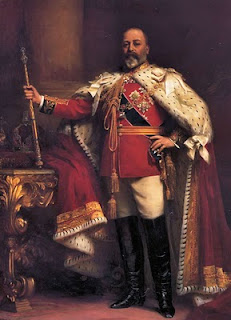
By mid-June the preparations were complete - the Abbey prepared and the many visiting royalties who had arrived in London were settling into their palaces. Then suddenly, twelve days before the ceremony, disaster loomed - the King fell seriously ill and, though he determinedly protested that he could not disappoint his guests, his doctors diagnosed appendicitis which required immediate surgery. There was no alternative but to postpone the coronation. Even then, no one could be sure that the King would survive surgery, as one doctor later confessed to Toria, he was sure ‘that His Majesty would die during the operation.’ Overweight, addicted to fine wines, gargantuan meals, fat cigars and pretty women, it seemed that the heir who had waited for so long to come to the throne would in the end be denied his inheritance.
For an anxious forty minutes in an adjoining room, Queen Alexandra waited with her daughters, Toria and Maud, while Mr. Treves performed the surgery. Yet somehow, against the odds, Bertie pulled through. Word of his recovery was greeted with rejoicing throughout the country and made the celebration of his coronation, two months later than planned, even more spectacular.
Behind the scenes came the usual family wrangling about the order of precedence. This time it was not the Kaiser• but his younger brother, Henry, who was most disgruntled at being placed towards the back during the ceremonies. His temper was soothed when his sister-in-law, Victoria Battenberg, now settled with her family in London, agreed to bring her children to spend Christmas with him and Irène at Kiel, providing him with the ideal opportunity to show off his new steam car and boat.
Paradoxically, his sister, Charlotte, who was so used to making mischief, had no complaints about the coronation. Recently recovered from one of her recurring bouts of illness, she thoroughly enjoyed the celebrations and wrote cheerfully from Sandringham:
“There is no place in the world like England, & if possible I’m more English than ever…Have made several trips with my Sailor Brother & other friends, running down to various lovely country houses…”
The accession of the new king, coinciding with the dawn of a new century, seemed to bring a new vitality to the country. The Boer War finally reached its conclusion and a precarious peace reigned in Europe. Queen Victoria’s old world had vanished overnight and the new court seemed suddenly young, modern and alive.
No two monarchs could have differed more starkly than the perpetually mourning widow of Windsor and the portly bon viveur, King Edward VII. From the moment he ascended the throne a great wind of change blew through the English palaces. On the King’s instructions, out went the late Queen’s numerous mementos of her stalwart John Brown; modern styles replaced the old Victorian décor; and the hushed and smoke-free rooms of Buckingham Palace echoed to the sound of cigar-puffing Sybarites. In Windsor, too, the king implemented changes:
“The moving of inanimate objects such as furniture and pictures does not jar,” wrote Alick York, Groom in Waiting to the late Queen, “and I must say the 3 drawing rooms are more comfortably and artistically arranged than in the old days, but still it all seems as if someone was taking a liberty and I should wake up to find things and people restored to their old places.”
More distressing for Bertie’s sisters was his decision to donate the Queen’s beloved Osborne House to the nation. To the princesses it had always been a beautiful holiday home filled with happy memories and the added attraction of having been personally designed by the Prince Consort. To Bertie it symbolised all the pain of his repressed childhood. What was more, he loved Sandringham and London and had no intention of escaping, as his mother had so often done, from the bustle and noise of the city to the peaceful seclusion of the Isle of Wight, which bored him. Notwithstanding his love of the pleasures of life, the King had more in mind than redecorating his palaces. Throughout his sixty years of waiting, he had formed clear and incisive ideas about how to govern the realm. His talents may have been overlooked in Queen Victoria’s lifetime, but now he would bring them to the fore; and nowhere was he more suited to his new role than in his ability to court not only the public, but also foreign governments by his charm, tact and diplomacy. As long as Uncle Bertie lived, peace in Europe seemed secure.

While the King’s cronies revelled in the glamour of Edward VII’s Court, and the new Queen Alexandra basked in the affection of her husband’s subjects, her father’s accession did nothing to ease the burden of unhappy Toria. As her elder sister, Louise - created Princess Royal in 1905 - continued to enjoy her reclusive life with her small family, and Maud and her sailor prince seemed to sink into obscurity in Denmark, Toria was obliged, more frequently than ever, to follow at her parents’ heels on their numerous royal visits. As her illnesses multiplied, her reputation for hypochondria spread; hearing that the princess had slipped and fallen during a ball at the height of the London season in 1903, the Grand Duchess of Mecklenburg-Strelitz commented acerbically, “But oh! Poor…Victoria’s fall, truly grievous, she who is already so delicate.” Most of the family shared her sentiments.
It did not ease the unhappy princess’s burden to watch her younger cousins walking to the altar to be married. In February 1905, she attended the wedding of Uncle Leopold’s daughter, Alice of Albany, to Prince Alexander (‘Alge’) of Teck, younger brother of Princess May, the Duchess of York. Although almost ten years older than his bride, there was much to commend the Eton-educated Alge. Handsome and dashing in his cavalry officer’s uniform, he had seen active service during the South African war and had even been mentioned in dispatches during the siege of Mafeking. The wedding, which took place in St. George’s Chapel, Windsor was, according to Princess May ‘a most cheerful’ occasion with ‘no crying & At. Helen [the bride’s mother, the Duchess of Albany] behaved like a brick.’
A colourful gathering of royalties attended the ceremony, including Alice’s cousin, Queen Wilhelmina of the Netherlands, and among the bridesmaids were two other cousins, Daisy and Patsy Connaught the elder of whom was soon to marry the sober and scholarly, Prince Gustav of Sweden. Following a honeymoon in Cannes, the newly-weds, at Uncle Bertie’s invitation, settled into apartments at Windsor Castle from where the lively Alice had easy access to all the parties and dances of the capital. The couple travelled frequently, visiting Alice’s brother the Duke of Coburg and representing the king in such distant places as South Africa and the Far East.
In spite of the age difference, it was a remarkably happy marriage that produced three children, May, Rupert and Maurice, the youngest of whom died tragically before his first birthday. The sorrow was made all the greater for his parents as they were away in Coburg at the time, visiting Alice’s brother. Little Maurice, it seemed, had inherited his grandfather’s haemophilia•.

Four months after Alice’s wedding, the royalties returned to Windsor for Daisy Connaught’s wedding. The beautiful Daisy had a choice of several eminently suitable candidates, among them the Crown Prince of Portugal and the arrogant King Alfonso XVIII of Spain, but in 1905, during a visit to Egypt, she met and fell in love with Gustav, heir apparent to the Swedish throne. By the end of the holiday, the couple were engaged and the wedding took place at Windsor on June 15th.
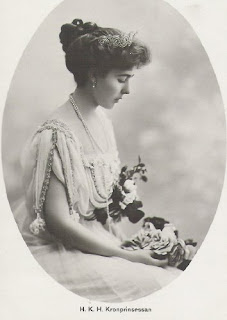
Daisy’s gentle nature and striking beauty soon won the hearts of the Swedish people.
“Daisy was unique:” wrote her cousin Marie Louise, “she possessed the most beautiful character and I can truthfully say was beloved by all who had the privilege of knowing her.”
Two years after her marriage, King Oskar died and she rose to the rank of Crown Princess. Hers too was a happy marriage, resulting in a daughter, Ingrid, and five sons: Gustav, Adolph, Sigvard, Bertil and Carl Johann.

While Alice and Daisy were celebrating their weddings, their cousin, Ducky, was living down the scandal of her recent divorce. For years she had known that her unhappy union with Ernie was irreparable and only respect for her grandmother had prevented her from making the final break. The whole family was well aware that the couple were living apart - Ernie remaining in Darmstadt, while Ducky occupied her mother’s villa in Nice where she frequently entertained her lover, Grand Duke Kyril. Now that Queen Victoria was gone, there was no reason to prolong the intolerable situation and at last on 21st December 1901 the divorce was officially announced on the grounds of ‘invincible mutual apathy.’
The not unexpected news might have come as a relief to the Edinburgh family but to Ernie’s sisters it struck as a double blow. Not only had they been relying on Ducky to provide an heir for the Grand Duchy of Hesse but they dreaded the scandal if, in the course of the divorce proceedings, the allegations of Ernie’s homosexuality should be made public. The Tsarina, mindful that Ducky’s lover was first cousin of the Tsar, feared that she may excuse her behaviour by revealing the reason for her dissatisfaction with Ernie. In an earnest attempt to limit the damage, Alix wrote a carefully worded letter to Nicky’s sister, Xenia, professing to pass no judgement on her cousin, while insinuating that she, not Ernie was to blame:
“It nearly broke my heart when I got the news, it was so quite unexpected, I always hoped that in time things would come right…Only with her character married life thus was impossible to continue…Only one thing I entreat you, darling Xenia, whenever you hear nasty gossip, at once put a stop to it for their sakes and ours. They parted as their characters could impossibly get on together, that is enough for the public…She will not be missed in the country, as she never made herself beloved nor showed any liking for the country, alas! Poor girl she is utterly miserable now without a home, tho’ he leaves her the sweet child.”
Though Ducky kept the ‘sweet child,’ Elizabeth, she had no objection to allowing her
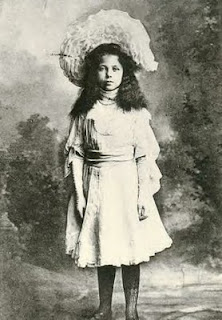
to stay with Ernie for several months each year. Ernie entertained her in Darmstadt or took her with him to visit his numerous relations. In autumn 1903, the Tsar invited them to join the Imperial Family at his hunting lodge in Poland where, within days of their arrival, eight-year-old Elizabeth fell seriously ill with typhoid. Her aunt, the Tsarina, decided that there was no cause for alarm and delayed sending for her mother so that by the time Ducky heard of her illness at the beginning of November, the little girl was already dead. Ernie’s sisters, Victoria and Ella rushed to Darmstadt for the funeral where Ernie and Ducky were briefly reconciled in grief.
Two years later, Ernie found a far more compatible wife in Princess Eleonore (‘Onor’) of Lich - ‘a dignified and gracious lady and gifted with a genuine talent for dress.’ Unlike her predecessor, Onor was happy to take over many of Princess Alice’s charities and proved a very popular Grand Duchess of Hesse. In spite of Ernie’s alleged homosexuality, he found happiness with Onor, by whom he fathered two more children - George Donatus and Ludwig.
For Ducky, life was far less serene. Her ex-husband was free to take a new wife but the Orthodox Church, unable to alter its stance on marriage between first cousins, could not sanction a wedding with Kyril. Even if Kyril was prepared to defy the Church, he, as a member of the Imperial Family, need the Tsar’s permission to marry - permission that Nicky, swayed by Alix, was almost certain to refuse.
While Ducky, morose and despairing, mooched around Nice, the eccentric Queen Elizabeth of Roumania suggested that she should resign herself to a single life and concentrate on serving others, to:
“Go and learn how to nurse, form a sisterhood of her own, wander about the world in search of all the suffering, all the misery, all those that life has treated hardly. Lead a life of continual sacrifice.”
Queen Elizabeth had little idea how accurately she described the kind of life that Ducky’s cousin, Ella, was soon to adopt• but for the Edinburgh princess, such a plan was unthinkable. So deep was Ducky’s unhappiness that even her staunchly Orthodox mother pleaded with Nicky to allow her to marry Kyril in secret but, with Alix vehemently opposed to the scheme, Nicky stood firm.
From Nice, Ducky watched anxiously as Kyril saw active service with the Russian fleet during the Japanese War of 1904-5• escaping death by a whisker when his ship, the Petropavlovsk, was sunk by an enemy mine. Surely, she hoped, his heroic return would persuade the Tsar to lift the ban, but Nicky remained intransigent. Worn out with pleading and waiting, Kyril decided to take matters into his own hands. In autumn 1905, he arranged to meet Ducky at her mother’s home in Tergensee in Bavaria where on Sunday October 8th they were secretly married.
When the news reached Russia Alix was incensed, and Kyril’s arrival at Tsarskoe Selo a few days later did nothing to appease her anger. Denying the Grand Duke access to the Alexander Palace, she ensured that Nicky imposed on him the full penalty for disobeying the Tsar; Kyril was stripped of his titles and banished from the country. Only two years later, when Ducky gave birth to a daughter, Maria, and converted to Orthodoxy, did Nicky agree to endorse the marriage and restore the Grand Duke’s title. Still relations with the Imperial family were so taut that Kyril and Ducky opted to remain in Paris until after the birth of a second daughter, Kira, in 1909.
It was, perhaps, as well that they remained away from St. Petersburg, for their exile coincided with one of the most horrifying and tumultuous periods in the reign of Tsar Nicholas II.

"Uncle Bertie" - More of Queen Victoria's Granddaughters


Of all her nine children, none had caused the Queen as much consternation as her eldest son and heir. Compared throughout his childhood to his elder and more brilliant sister, Vicky, Bertie could not have been a greater disappointment to his parents. His lack of enthusiasm for study, his inability to learn, even his appearance distressed his mother to the extent that she feared that he had inherited the wayward characteristics of her degenerate Hanoverian uncles.
The Queen was haunted by the memory of those ‘terrible’ uncles who, a generation earlier, had brought the royal family into such disrepute. Since her accession both she and Prince Albert had worked hard to restore the reputation of the monarchy, presenting the nation with an ideal example of marital fidelity and domestic harmony that was beyond reproach. No one, least of all their eldest son, could be permitted to tarnish that image and, from his earliest years, Bertie’s parents aimed to mould him into their ideal of the perfect prince. To prevent the taint of any outside influence, he was isolated from boys of his own age and provided instead with strict tutors and even stricter regimes of study. The scheme was not a success. Bertie, criticised on all sides, struggled in the schoolroom while his natural gifts of diplomacy and congeniality were stifled and ignored. When his frustration exploded in rage, he was beaten.
Unsurprisingly, the young prince leaped at the first chance of freedom. Escaping from the ‘minders’ sent to protect him (or rather his morals) during his student days at Cambridge, he sought the kind of friends who were the antithesis of his parents and who encouraged his budding interest in drinking, gambling and fine cigars. During the university vacation in the summer of 1861, while he was attached to a regiment of guards stationed at the Curragh near Dublin, his companions managed to smuggle a pretty actress into his rooms. That night, the delighted prince embarked upon a womanising career that would continue for the rest of his life.
When word of his escapade reached Windsor, the pious Prince Consort was appalled. Although already exhausted and probably suffering from the typhoid• that finally killed him, he set out at once to Cambridge. On a wet November afternoon, father and son walked for hours in the rain, Prince Albert expressing his disappointment and disgust at Bertie’s foolishness and warning him that such scandals could pose a threat to the monarchy. Bertie was duly repentant but by the time his father returned to Windsor, his health was already failing.
The Queen refused to believed that her angelic husband was dying, and when the end came, less than a month after his visit to Cambridge, she was convinced his death was due to the shock of Bertie’s ‘fall.’ For months she could hardly bear to look at her son ‘without a shudder’ and found it virtually impossible to forgive him no matter how hard she tried. Nevertheless, he was ‘My dear Angel’s own child - our Firstborn’ and would one day be king so to deliver him from further temptation, he urgently needed a wife.
Even before Prince Albert’s death, Vicky had been entrusted with the difficult task of finding a suitable bride for her brother. Detailed with the necessary qualities - good health and looks, unsullied background and preferably a German - she had scoured the pages of the Almanac of Gotha, the bible of royal matchmakers, and made lists of all the available young princesses she had met in European courts. The Queen read her detailed reports with interest and, having rejected various others on the grounds of bad teeth, a frail constitution, or adherence to the wrong religion, she noted that one princess stood out above all - Alexandra, the attractive seventeen-year-old daughter of Crown Prince Christian of Denmark.
“She is the sweetest girl who ever lived,” Vicky informed her mother, “and full of life and spirits…She has always been strong and healthy as possible and has never ailed anything in her life except having the measles…I own Princess A. of Holstein is the only one of these princesses for whom I feel portée – it would be dreadful if this pearl went to the horrid Russians.”
Intrigued by Vicky’s effusive descriptions, the Queen decided that the princess was worth ‘looking over’ and arranged a meeting on neutral ground, the Laeken Palace in Brussels. From the first encounter, Queen Victoria was enchanted and wrote enthusiastically to Vicky assuring her that, though Alexandra suffered from a slight deafness, her recommendation was perfect - what a pity she wasn’t German! By the time that Bertie was introduced to her, his mother and sister had effectively decided that Alexandra was to be his bride. The wedding took place in March 1863 - an occasion marred only by the behaviour of four-year-old Willy of Prussia. who squealed throughout the service and bit and kicked his young uncles Arthur and Leopold when they tried to restrain him.
Ten months later, Alexandra did her duty by providing the country with an heir, Prince Albert Victor, (‘Eddy’) - “a perfect bijou,” in the Queen’s opinion, “ –very fairy-like but quite healthy, very wise-looking and good…He is very placid almost melancholy-looking.”
The following year a second son, George, was born but the lure of a beautiful wife and the responsibilities of fatherhood did little to quell Bertie’s love of the high life. Unable to win the Queen’s confidence and consequently denied any serious role in constitutional affairs, he passed his time in an endless round of parties, race going and shooting with the ‘Marlborough House Set’ of fast living, wealthy and fashionable cronies who shared his taste for eating, drinking, gambling and womanising.
Reports of the goings on at Marlborough House irritated and worried the Queen. While she could not deny that the beautiful Alexandra had undoubtedly won the hearts of her people, she had turned out to be a naïve and rather empty-headed young woman whose persistent unpunctuality drove Bertie to such despair that he eventually ordered all the clocks in Sandringham to be set half-an-hour fast.
“I am sorry too for Bertie;” Queen Victoria complained to Vicky, “I don’t think she makes his home comfortable; she is never ready for breakfast - not being out of her room till 11 often, and Bertie breakfasts alone and then she alone.”
Still worse, in her mother-in-law’s opinion, Alexandra shared her husband’s love of entertaining to the extent that the Queen felt obliged to warn her that such frivolous behaviour would not only ruin the reputation of the royal family but the late nights would ruin her health and that of her ‘frail puny’ babies who lacked the robust constitutions of their German cousins.
Bertie and Alexandra paid little heed to the warnings, and in the winter of 1866-7 the Queen’s predictions proved accurate. During the course of her third pregnancy, the princess contracted rheumatic fever and lay for several days in a critical condition. While the country anxiously awaited news, Bertie ignored the telegrams urging him to return to London and remained instead at the Windsor races. Even when he did eventually arrive at Marlborough House and made the token gesture of moving his desk to his wife’s bedside, he continued to entertain his rowdy friends while she lay on her sickbed upstairs.
On 20th February 1867, after a tortuous labour unrelieved by chloroform, Alexandra gave birth to a daughter, Louise (whom the Queen believed should have been named Victoria - ‘but upon those subjects Bertie and Alix do not understand the right thing.’). Three months later the baby was christened by the Archbishop of Canterbury at Marlborough House where her godparents included three of her aunts - Alice, Lenchen and Beatrice.
Though the Princess of Wales gradually regained her strength, the illness had accentuated her deafness and left her with a permanent limp•. Throughout her protracted convalescence, Bertie embarked on numerous affairs so openly that even the Queen was to comment that her daughter-in-law’s lot was not an easy one. As rumours of his neglect became known, his reputation plummeted, reaching its nadir when he was cited in the infamous Mordaunt case. While suffering from post-natal depression Lady Harriet Mordaunt, a close friend of the prince, confessed to her husband that the child’s father could have been one of several highly placed men including the Prince of Wales. Her outraged husband immediately began divorce proceedings and Bertie was called to court. Though he acquitted himself well and Lady Mordaunt was declared insane, his standing in the eyes of the public seemed irreparably damaged. Hissed in the theatre and jeered in the street, he seemed very much in danger of doing precisely what his mother had feared and destroying the image of the monarchy. Yet, neither public outcry nor family criticism could curtail his pleasure seeking.
By a strange freak of fortune it took a near-disaster to restore his tarnished image. In the winter of 1871 he contracted typhoid and for several days his life was despaired of. His sister Alice, who been staying at Balmoral with the Queen, was soon at his bedside playing the same role as she had played during her father’s fatal illness a decade before. On the 14th December - the tenth anniversary of the Prince Consort’s death, it appeared that Bertie was dying when quite unexpectedly in the evening he began to rally. The country rejoiced at his recovery and the Queen forced herself from her seclusion to attend a thanksgiving service at St. Paul’s Cathedral after which she appeared in public on the balcony of Buckingham Palace for the first time since her widowhood. When at last the Queen returned home satisfied that the monarchy was secure and certain that Bertie’s brush with death would lead him to adopt a less frivolous lifestyle. It was a vain hope. With so few responsibilities to occupy him it was not long before he returned to his old routine of gambling, shooting and womanising.
Alexandra endured Bertie’s infidelities with a dignified silence, and bore him two more daughters - Victoria (Toria) on July 6th 1868, and Maud a year later. A third son, Alexander, was born at Sandringham in 1871 but died within hours of his birth.
If her husband failed to give Alexandra the attention she craved she was determined to receive it from her children. Jealously overprotective, she virtually smothered them with affection. No aspect of their lives escaped the notice of ‘Motherdear’ leaving Queen Victoria to complain that she spoiled them terribly. For all her glamorous lifestyle, she was in constant attendance in the nursery, bathing the babies and tucking them into bed each evening before donning her jewels and ball gowns to entrance her guests at dinner.
To the young German princesses, dazzled by the glamour of the Marlborough House Set, it must have come as a surprise to find their Wales cousins so insipid. Of the three girls, only Maud, whose love of the outdoor life and manner of speaking in schoolboy slang earned her the nickname ‘Harry’, showed any of the spirit common to her cousins. The ‘frail puny babies’ grew into frail puny children, constantly prone to colds, toothache, abscesses, sciatica and a myriad of other real or imaginary ailments. So fearful was Louise for her health that she took her physician on holiday with her, while ‘precious’ Toria collapsed at the slightest provocation.
“The children are very dear and pretty,” observed Alice, “but my boy is as tall as little Louise, and of course much bigger.”
Even when they were well, they were hardly the most scintillating companions for their highly-educated cousins. Unlike her sisters-in-law, the Princess of Wales saw little need to tax her daughters with learning and Bertie’s recollection of his own miserable years in the schoolroom made him loath to inflict the same torture on his children. Maud was an able linguist and Louise a talented musician, but their education was so haphazard that Queen Victoria despaired of their ignorance and lack of serious interest in anything.
“Alix and I never will or can be intimate;” she wrote in exasperation, “she shows me no confidence whatsoever especially about the children...”
Occasionally the girls accompanied their mother to hospitals and the homes of their Sandringham tenants but, for the most part, life beyond the narrow confines of their nursery remained a mystery to them. They lived and played in their own sheltered world, innocently delighting in each other’s company to the extent that Queen Victoria complained that Alexandra was ‘unfortunately most unreasonable and injudicious about her children.’ On one point, however, Alexandra satisfied the Queen by insisting on raising her with “…great simplicity and an absence of all pride.”
Unfortunately, the ‘absence of all pride’ was coupled with a complete lack of confidence. With the exception of Maud, who had inherited her mother’s fine features, they were not pretty girls and, overshadowed by their charismatic parents, they found few occasions to shine. Unused to the company of strangers, their diffidence left them tongue-tied in social gatherings and warranted the cruel if apt epithets ‘the whispering Waleses’ and ‘their Royal Shynesses.’
“They always, if I can so express it,” wrote their cousin Marie of Edinburgh, “spoke in a minor key en sourdine. It gave a special quality to all talks with them, and gave me a strange sensation, as though life would have been very wonderful and everything very beautiful, if it had not been so sad.”
Even as they grew into their late teens, Alexandra was determined to keep them as little children, making them emotionally and intellectually far younger than their years. Princess May of Teck, who would eventually marry their brother, George, was astonished to attend a birthday party for nineteen-year-old Louise only to discover that it was to be a children’s tea party. Their ‘sweet and prettily arranged’ rooms, cluttered with ornaments, shells and souvenirs, resembled nurseries and they continued to refer to each other by childish nicknames - Toots, Gawks and Snipey. They found their greatest enjoyment in games and giddy pranks, which doubtless bored the more serious Hessians and were treated with contempt by the proud Hohenzollerns.
Not that the Germans’ opinion was of any consequence to the Danish Princess of Wales. Since Bismarck’s seizure of Schleswig-Holstein from Denmark she made no secret of her hatred of all things German - and more especially Prussian. That in itself was sufficient to alienate her from other members of the family and causing the Queen to moan that ‘her feelings are so anti-German and yet so little really English that she is no real help – good, kind, dear as she is and much as I love her.’
For Vicky, whom she liked, Alexandra made an exception, but her prejudice was never more in evidence than when it came to the wedding of Bertie’s younger sister, Lenchen.

Bertie and Queen Victoria's passing


When Queen Victoria died in January 1901, the whole of Europe seemed to reel in shock at the end of a magnificent era. Her granddaughter, the then Crown Princess Marie of Roumania, wrote: "To see it all again if only for a day or two…to have a last peep at the old house…with out dear old Granny the last link is cut off!...I tell you it is inconceivable sorrow for me..."
Another granddaughter, Alice Albany (later of Athlone) wrote: "I had come to regard her as permanent and indestructible - like England and Windsor Castle.”

And a granddaughter-in-law, the future Queen Mary of England wrote: "The thought of England without the Queen is dreadful even to think of. God help us all.”

However, her heir, Bertie, King Edward VII, while dutifully paying his respects to his mother, seemed to breathe a huge sigh of relief and took very little time to throw out many vestiges of her reign. Statues of her favourite servant, John Brown, were disposed of in no time; Buckingham Palace was redecorated and Osborne House was given to the nation (with the exception of the Queen's rooms, which were for many decades gated off).

It might seem quite cold that Bertie should change everything so quickly and, at the same time, the Queen's passing was the passing of a person whose name had become synonymous with all that was best and worst of almost a century. Even to this day, the epithet of 'the Victorians' evokes so many images and it is interesting to look at the small woman who created such a mystique, with which her eldest son was so eager to dispense. "The Albertian era" would probably be more accurate a description of that time, since virtually all of the Queen's positive influence came from the influence of beloved Albert.

For Bertie, though, life in such a household was not an age of enlightenment, but an age of incarceration and asphyxiation. He was unfortunate in being the eldest son of a mother who had such fear of anyone in her family turning out like her 'wicked' Hanoverian uncles, and a father whose horror of infidelity sprang from the effects of his earliest childhood. These parents wanted to do the very best for their son - to keep him 'pure' and turn him into the ideal prince, and eventual king. Instead, unwittingly, they attempted unsuccessfully to curb everything which they saw as 'wrong' and to mould him into their image of what was perfect. Small wonder the poor boy sought outlets in excess; small wonder, too, that while he loved his parents, he strained at the bit and, eventually finding freedom, threw out so many relics of their era, which seemed to him the age of oppression.

Equally interesting is the speed with which Grand Duchess Elizabeth altered everything following the murder of her husband, Serge. Within a few months her life changed in such a way that it appears she must have been dreaming of something quite different for years. It's almost like a simmering, overheated engine that suddenly blows a gasket and it is shocking....but suddeny settles down into a quite different place. The influence of one person over another is tremendous but ultimately, everyone finds his/her own level and nothing lasts forever...

It's interesting that when someone passes on, there are those who choose to mourn for a length of time, and those who choose to move on. There's a weird obligation to feel sad about them, and about someone's passing and not to feel sad is seen as heartless but that isn't always the case. Bertie, without sentimentality, was surely correct. It was immensely sad that the era had gone...but to him a tyrant had let go of the reins and he was free.

It's a bit of a pity that Bertie didn't live long enough to really come into his stride and enjoy the power of his own benign influence for longer. King for only 9 years...had he lived as long as his mother did, I think the First World War might have been avoided.

Not a Romantic Story


Some years ago, a programme described the plight of orphans in an Eastern European country, who had been raised from their earliest years in a Spartan setting in which they were given everything necessary to keep them alive - food and drink - but totally deprived of any physical contact or warmth. Depriving them of hugs and touch was as damaging as depriving them of food.

Tonight, watching the repeat of the "Revelations" programme about Edward VIII, I had exactly the same impression. Here, it appeared, was a man who functioned without any warmth of personality or humanity - even his relationship with Wallis Simpson was an attempt to gratify his own needs rather than a great romance - a man who seemed to have no sense whatsoever of the effects of his behaviour on other people, or, if he did have any awareness of it, didn't care. It's small wonder when he had father who terrified him and a mother who didn't really like children. I doubt there was any warmth at all in his childhood and he behaved like an infant for most of his life. It's a tragic tale, really, and one that speaks volumes about the influences of parents and how the world is perceived as a child. Interestingly, none of the children of George V grew up without some kind of personality issue; they all seemed to want to punish themselves in one way or another - which isn't surprising when one considers their punishing childhood regimen. Bertie - King George VI - came out best, despite his stammer (surely the result of his childhood fears, too - and not being allowed to write with his natural left hand) and it is a source of continual bafflement to me why George V was so tyrannical and humourless and such a bully to his children when he came from a loving (if overbearing!) mother, and a father who loved all the pleasures of life...

Much is written about the 'stupidity' of George V's elder brother, Albert Victor, who died so young, but he was not half as stupid as he is generally portrayed. He was a warm man, and one who understood many important political questions of the day (Ireland, for example) and would probably have made a far better king than George V. I dare say, too, that Albert Victor would have not been a bully and would have dared to rescue the Tsar and his family...George V, to my mind, was a very nasty man and it is evidenced in the effects on his children.
Related Posts Plugin for WordPress, Blogger...