"Poor Girl, She is Utterly Miserable Now" - More of Queen Victoria's Granddaughters
The summer 1902 saw London bustling with preparations for the coronation of King Edward VII. So many years had passed since Queen Victoria’s accession that even the most aged courtiers had no recollection of the protocol of such ceremonies but for Bertie that posed few problems. Unlike his mother, the new king revelled in the limelight and what better way could there be to mark the beginning of a new reign than by the most impressive show of all - a coronation reflecting all the grandeur and pomp of the mighty British Empire. The organisation of the whole event was entrusted to Lord Esher with instructions that this was to be a spectacle to outshine all spectacles. 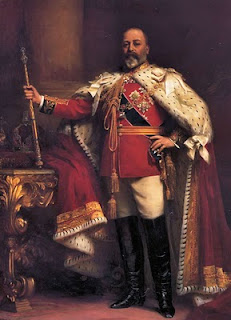
By mid-June the preparations were complete - the Abbey prepared and the many visiting royalties who had arrived in London were settling into their palaces. Then suddenly, twelve days before the ceremony, disaster loomed - the King fell seriously ill and, though he determinedly protested that he could not disappoint his guests, his doctors diagnosed appendicitis which required immediate surgery. There was no alternative but to postpone the coronation. Even then, no one could be sure that the King would survive surgery, as one doctor later confessed to Toria, he was sure ‘that His Majesty would die during the operation.’ Overweight, addicted to fine wines, gargantuan meals, fat cigars and pretty women, it seemed that the heir who had waited for so long to come to the throne would in the end be denied his inheritance.
For an anxious forty minutes in an adjoining room, Queen Alexandra waited with her daughters, Toria and Maud, while Mr. Treves performed the surgery. Yet somehow, against the odds, Bertie pulled through. Word of his recovery was greeted with rejoicing throughout the country and made the celebration of his coronation, two months later than planned, even more spectacular.
Behind the scenes came the usual family wrangling about the order of precedence. This time it was not the Kaiser• but his younger brother, Henry, who was most disgruntled at being placed towards the back during the ceremonies. His temper was soothed when his sister-in-law, Victoria Battenberg, now settled with her family in London, agreed to bring her children to spend Christmas with him and Irène at Kiel, providing him with the ideal opportunity to show off his new steam car and boat.
Paradoxically, his sister, Charlotte, who was so used to making mischief, had no complaints about the coronation. Recently recovered from one of her recurring bouts of illness, she thoroughly enjoyed the celebrations and wrote cheerfully from Sandringham:
“There is no place in the world like England, & if possible I’m more English than ever…Have made several trips with my Sailor Brother & other friends, running down to various lovely country houses…”
The accession of the new king, coinciding with the dawn of a new century, seemed to bring a new vitality to the country. The Boer War finally reached its conclusion and a precarious peace reigned in Europe. Queen Victoria’s old world had vanished overnight and the new court seemed suddenly young, modern and alive.
No two monarchs could have differed more starkly than the perpetually mourning widow of Windsor and the portly bon viveur, King Edward VII. From the moment he ascended the throne a great wind of change blew through the English palaces. On the King’s instructions, out went the late Queen’s numerous mementos of her stalwart John Brown; modern styles replaced the old Victorian décor; and the hushed and smoke-free rooms of Buckingham Palace echoed to the sound of cigar-puffing Sybarites. In Windsor, too, the king implemented changes:
“The moving of inanimate objects such as furniture and pictures does not jar,” wrote Alick York, Groom in Waiting to the late Queen, “and I must say the 3 drawing rooms are more comfortably and artistically arranged than in the old days, but still it all seems as if someone was taking a liberty and I should wake up to find things and people restored to their old places.”
More distressing for Bertie’s sisters was his decision to donate the Queen’s beloved Osborne House to the nation. To the princesses it had always been a beautiful holiday home filled with happy memories and the added attraction of having been personally designed by the Prince Consort. To Bertie it symbolised all the pain of his repressed childhood. What was more, he loved Sandringham and London and had no intention of escaping, as his mother had so often done, from the bustle and noise of the city to the peaceful seclusion of the Isle of Wight, which bored him. Notwithstanding his love of the pleasures of life, the King had more in mind than redecorating his palaces. Throughout his sixty years of waiting, he had formed clear and incisive ideas about how to govern the realm. His talents may have been overlooked in Queen Victoria’s lifetime, but now he would bring them to the fore; and nowhere was he more suited to his new role than in his ability to court not only the public, but also foreign governments by his charm, tact and diplomacy. As long as Uncle Bertie lived, peace in Europe seemed secure.

While the King’s cronies revelled in the glamour of Edward VII’s Court, and the new Queen Alexandra basked in the affection of her husband’s subjects, her father’s accession did nothing to ease the burden of unhappy Toria. As her elder sister, Louise - created Princess Royal in 1905 - continued to enjoy her reclusive life with her small family, and Maud and her sailor prince seemed to sink into obscurity in Denmark, Toria was obliged, more frequently than ever, to follow at her parents’ heels on their numerous royal visits. As her illnesses multiplied, her reputation for hypochondria spread; hearing that the princess had slipped and fallen during a ball at the height of the London season in 1903, the Grand Duchess of Mecklenburg-Strelitz commented acerbically, “But oh! Poor…Victoria’s fall, truly grievous, she who is already so delicate.” Most of the family shared her sentiments.
It did not ease the unhappy princess’s burden to watch her younger cousins walking to the altar to be married. In February 1905, she attended the wedding of Uncle Leopold’s daughter, Alice of Albany, to Prince Alexander (‘Alge’) of Teck, younger brother of Princess May, the Duchess of York. Although almost ten years older than his bride, there was much to commend the Eton-educated Alge. Handsome and dashing in his cavalry officer’s uniform, he had seen active service during the South African war and had even been mentioned in dispatches during the siege of Mafeking. The wedding, which took place in St. George’s Chapel, Windsor was, according to Princess May ‘a most cheerful’ occasion with ‘no crying & At. Helen [the bride’s mother, the Duchess of Albany] behaved like a brick.’
A colourful gathering of royalties attended the ceremony, including Alice’s cousin, Queen Wilhelmina of the Netherlands, and among the bridesmaids were two other cousins, Daisy and Patsy Connaught the elder of whom was soon to marry the sober and scholarly, Prince Gustav of Sweden. Following a honeymoon in Cannes, the newly-weds, at Uncle Bertie’s invitation, settled into apartments at Windsor Castle from where the lively Alice had easy access to all the parties and dances of the capital. The couple travelled frequently, visiting Alice’s brother the Duke of Coburg and representing the king in such distant places as South Africa and the Far East.
In spite of the age difference, it was a remarkably happy marriage that produced three children, May, Rupert and Maurice, the youngest of whom died tragically before his first birthday. The sorrow was made all the greater for his parents as they were away in Coburg at the time, visiting Alice’s brother. Little Maurice, it seemed, had inherited his grandfather’s haemophilia•.
Four months after Alice’s wedding, the royalties returned to Windsor for Daisy Connaught’s wedding. The beautiful Daisy had a choice of several eminently suitable candidates, among them the Crown Prince of Portugal and the arrogant King Alfonso XVIII of Spain, but in 1905, during a visit to Egypt, she met and fell in love with Gustav, heir apparent to the Swedish throne. By the end of the holiday, the couple were engaged and the wedding took place at Windsor on June 15th.
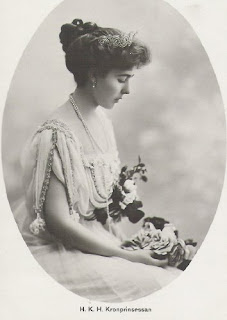
Daisy’s gentle nature and striking beauty soon won the hearts of the Swedish people.
“Daisy was unique:” wrote her cousin Marie Louise, “she possessed the most beautiful character and I can truthfully say was beloved by all who had the privilege of knowing her.”
Two years after her marriage, King Oskar died and she rose to the rank of Crown Princess. Hers too was a happy marriage, resulting in a daughter, Ingrid, and five sons: Gustav, Adolph, Sigvard, Bertil and Carl Johann.
While Alice and Daisy were celebrating their weddings, their cousin, Ducky, was living down the scandal of her recent divorce. For years she had known that her unhappy union with Ernie was irreparable and only respect for her grandmother had prevented her from making the final break. The whole family was well aware that the couple were living apart - Ernie remaining in Darmstadt, while Ducky occupied her mother’s villa in Nice where she frequently entertained her lover, Grand Duke Kyril. Now that Queen Victoria was gone, there was no reason to prolong the intolerable situation and at last on 21st December 1901 the divorce was officially announced on the grounds of ‘invincible mutual apathy.’
The not unexpected news might have come as a relief to the Edinburgh family but to Ernie’s sisters it struck as a double blow. Not only had they been relying on Ducky to provide an heir for the Grand Duchy of Hesse but they dreaded the scandal if, in the course of the divorce proceedings, the allegations of Ernie’s homosexuality should be made public. The Tsarina, mindful that Ducky’s lover was first cousin of the Tsar, feared that she may excuse her behaviour by revealing the reason for her dissatisfaction with Ernie. In an earnest attempt to limit the damage, Alix wrote a carefully worded letter to Nicky’s sister, Xenia, professing to pass no judgement on her cousin, while insinuating that she, not Ernie was to blame:
“It nearly broke my heart when I got the news, it was so quite unexpected, I always hoped that in time things would come right…Only with her character married life thus was impossible to continue…Only one thing I entreat you, darling Xenia, whenever you hear nasty gossip, at once put a stop to it for their sakes and ours. They parted as their characters could impossibly get on together, that is enough for the public…She will not be missed in the country, as she never made herself beloved nor showed any liking for the country, alas! Poor girl she is utterly miserable now without a home, tho’ he leaves her the sweet child.”
Though Ducky kept the ‘sweet child,’ Elizabeth, she had no objection to allowing her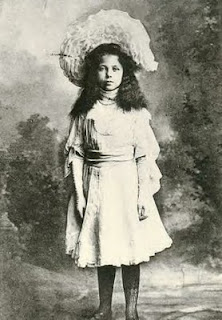
to stay with Ernie for several months each year. Ernie entertained her in Darmstadt or took her with him to visit his numerous relations. In autumn 1903, the Tsar invited them to join the Imperial Family at his hunting lodge in Poland where, within days of their arrival, eight-year-old Elizabeth fell seriously ill with typhoid. Her aunt, the Tsarina, decided that there was no cause for alarm and delayed sending for her mother so that by the time Ducky heard of her illness at the beginning of November, the little girl was already dead. Ernie’s sisters, Victoria and Ella rushed to Darmstadt for the funeral where Ernie and Ducky were briefly reconciled in grief.
Two years later, Ernie found a far more compatible wife in Princess Eleonore (‘Onor’) of Lich - ‘a dignified and gracious lady and gifted with a genuine talent for dress.’ Unlike her predecessor, Onor was happy to take over many of Princess Alice’s charities and proved a very popular Grand Duchess of Hesse. In spite of Ernie’s alleged homosexuality, he found happiness with Onor, by whom he fathered two more children - George Donatus and Ludwig.
For Ducky, life was far less serene. Her ex-husband was free to take a new wife but the Orthodox Church, unable to alter its stance on marriage between first cousins, could not sanction a wedding with Kyril. Even if Kyril was prepared to defy the Church, he, as a member of the Imperial Family, need the Tsar’s permission to marry - permission that Nicky, swayed by Alix, was almost certain to refuse.
While Ducky, morose and despairing, mooched around Nice, the eccentric Queen Elizabeth of Roumania suggested that she should resign herself to a single life and concentrate on serving others, to:
“Go and learn how to nurse, form a sisterhood of her own, wander about the world in search of all the suffering, all the misery, all those that life has treated hardly. Lead a life of continual sacrifice.”
Queen Elizabeth had little idea how accurately she described the kind of life that Ducky’s cousin, Ella, was soon to adopt• but for the Edinburgh princess, such a plan was unthinkable. So deep was Ducky’s unhappiness that even her staunchly Orthodox mother pleaded with Nicky to allow her to marry Kyril in secret but, with Alix vehemently opposed to the scheme, Nicky stood firm.
From Nice, Ducky watched anxiously as Kyril saw active service with the Russian fleet during the Japanese War of 1904-5• escaping death by a whisker when his ship, the Petropavlovsk, was sunk by an enemy mine. Surely, she hoped, his heroic return would persuade the Tsar to lift the ban, but Nicky remained intransigent. Worn out with pleading and waiting, Kyril decided to take matters into his own hands. In autumn 1905, he arranged to meet Ducky at her mother’s home in Tergensee in Bavaria where on Sunday October 8th they were secretly married.
When the news reached Russia Alix was incensed, and Kyril’s arrival at Tsarskoe Selo a few days later did nothing to appease her anger. Denying the Grand Duke access to the Alexander Palace, she ensured that Nicky imposed on him the full penalty for disobeying the Tsar; Kyril was stripped of his titles and banished from the country. Only two years later, when Ducky gave birth to a daughter, Maria, and converted to Orthodoxy, did Nicky agree to endorse the marriage and restore the Grand Duke’s title. Still relations with the Imperial family were so taut that Kyril and Ducky opted to remain in Paris until after the birth of a second daughter, Kira, in 1909.
It was, perhaps, as well that they remained away from St. Petersburg, for their exile coincided with one of the most horrifying and tumultuous periods in the reign of Tsar Nicholas II.

By mid-June the preparations were complete - the Abbey prepared and the many visiting royalties who had arrived in London were settling into their palaces. Then suddenly, twelve days before the ceremony, disaster loomed - the King fell seriously ill and, though he determinedly protested that he could not disappoint his guests, his doctors diagnosed appendicitis which required immediate surgery. There was no alternative but to postpone the coronation. Even then, no one could be sure that the King would survive surgery, as one doctor later confessed to Toria, he was sure ‘that His Majesty would die during the operation.’ Overweight, addicted to fine wines, gargantuan meals, fat cigars and pretty women, it seemed that the heir who had waited for so long to come to the throne would in the end be denied his inheritance.
For an anxious forty minutes in an adjoining room, Queen Alexandra waited with her daughters, Toria and Maud, while Mr. Treves performed the surgery. Yet somehow, against the odds, Bertie pulled through. Word of his recovery was greeted with rejoicing throughout the country and made the celebration of his coronation, two months later than planned, even more spectacular.
Behind the scenes came the usual family wrangling about the order of precedence. This time it was not the Kaiser• but his younger brother, Henry, who was most disgruntled at being placed towards the back during the ceremonies. His temper was soothed when his sister-in-law, Victoria Battenberg, now settled with her family in London, agreed to bring her children to spend Christmas with him and Irène at Kiel, providing him with the ideal opportunity to show off his new steam car and boat.
Paradoxically, his sister, Charlotte, who was so used to making mischief, had no complaints about the coronation. Recently recovered from one of her recurring bouts of illness, she thoroughly enjoyed the celebrations and wrote cheerfully from Sandringham:
“There is no place in the world like England, & if possible I’m more English than ever…Have made several trips with my Sailor Brother & other friends, running down to various lovely country houses…”
The accession of the new king, coinciding with the dawn of a new century, seemed to bring a new vitality to the country. The Boer War finally reached its conclusion and a precarious peace reigned in Europe. Queen Victoria’s old world had vanished overnight and the new court seemed suddenly young, modern and alive.
No two monarchs could have differed more starkly than the perpetually mourning widow of Windsor and the portly bon viveur, King Edward VII. From the moment he ascended the throne a great wind of change blew through the English palaces. On the King’s instructions, out went the late Queen’s numerous mementos of her stalwart John Brown; modern styles replaced the old Victorian décor; and the hushed and smoke-free rooms of Buckingham Palace echoed to the sound of cigar-puffing Sybarites. In Windsor, too, the king implemented changes:
“The moving of inanimate objects such as furniture and pictures does not jar,” wrote Alick York, Groom in Waiting to the late Queen, “and I must say the 3 drawing rooms are more comfortably and artistically arranged than in the old days, but still it all seems as if someone was taking a liberty and I should wake up to find things and people restored to their old places.”
More distressing for Bertie’s sisters was his decision to donate the Queen’s beloved Osborne House to the nation. To the princesses it had always been a beautiful holiday home filled with happy memories and the added attraction of having been personally designed by the Prince Consort. To Bertie it symbolised all the pain of his repressed childhood. What was more, he loved Sandringham and London and had no intention of escaping, as his mother had so often done, from the bustle and noise of the city to the peaceful seclusion of the Isle of Wight, which bored him. Notwithstanding his love of the pleasures of life, the King had more in mind than redecorating his palaces. Throughout his sixty years of waiting, he had formed clear and incisive ideas about how to govern the realm. His talents may have been overlooked in Queen Victoria’s lifetime, but now he would bring them to the fore; and nowhere was he more suited to his new role than in his ability to court not only the public, but also foreign governments by his charm, tact and diplomacy. As long as Uncle Bertie lived, peace in Europe seemed secure.

While the King’s cronies revelled in the glamour of Edward VII’s Court, and the new Queen Alexandra basked in the affection of her husband’s subjects, her father’s accession did nothing to ease the burden of unhappy Toria. As her elder sister, Louise - created Princess Royal in 1905 - continued to enjoy her reclusive life with her small family, and Maud and her sailor prince seemed to sink into obscurity in Denmark, Toria was obliged, more frequently than ever, to follow at her parents’ heels on their numerous royal visits. As her illnesses multiplied, her reputation for hypochondria spread; hearing that the princess had slipped and fallen during a ball at the height of the London season in 1903, the Grand Duchess of Mecklenburg-Strelitz commented acerbically, “But oh! Poor…Victoria’s fall, truly grievous, she who is already so delicate.” Most of the family shared her sentiments.
It did not ease the unhappy princess’s burden to watch her younger cousins walking to the altar to be married. In February 1905, she attended the wedding of Uncle Leopold’s daughter, Alice of Albany, to Prince Alexander (‘Alge’) of Teck, younger brother of Princess May, the Duchess of York. Although almost ten years older than his bride, there was much to commend the Eton-educated Alge. Handsome and dashing in his cavalry officer’s uniform, he had seen active service during the South African war and had even been mentioned in dispatches during the siege of Mafeking. The wedding, which took place in St. George’s Chapel, Windsor was, according to Princess May ‘a most cheerful’ occasion with ‘no crying & At. Helen [the bride’s mother, the Duchess of Albany] behaved like a brick.’
A colourful gathering of royalties attended the ceremony, including Alice’s cousin, Queen Wilhelmina of the Netherlands, and among the bridesmaids were two other cousins, Daisy and Patsy Connaught the elder of whom was soon to marry the sober and scholarly, Prince Gustav of Sweden. Following a honeymoon in Cannes, the newly-weds, at Uncle Bertie’s invitation, settled into apartments at Windsor Castle from where the lively Alice had easy access to all the parties and dances of the capital. The couple travelled frequently, visiting Alice’s brother the Duke of Coburg and representing the king in such distant places as South Africa and the Far East.
In spite of the age difference, it was a remarkably happy marriage that produced three children, May, Rupert and Maurice, the youngest of whom died tragically before his first birthday. The sorrow was made all the greater for his parents as they were away in Coburg at the time, visiting Alice’s brother. Little Maurice, it seemed, had inherited his grandfather’s haemophilia•.
Four months after Alice’s wedding, the royalties returned to Windsor for Daisy Connaught’s wedding. The beautiful Daisy had a choice of several eminently suitable candidates, among them the Crown Prince of Portugal and the arrogant King Alfonso XVIII of Spain, but in 1905, during a visit to Egypt, she met and fell in love with Gustav, heir apparent to the Swedish throne. By the end of the holiday, the couple were engaged and the wedding took place at Windsor on June 15th.

Daisy’s gentle nature and striking beauty soon won the hearts of the Swedish people.
“Daisy was unique:” wrote her cousin Marie Louise, “she possessed the most beautiful character and I can truthfully say was beloved by all who had the privilege of knowing her.”
Two years after her marriage, King Oskar died and she rose to the rank of Crown Princess. Hers too was a happy marriage, resulting in a daughter, Ingrid, and five sons: Gustav, Adolph, Sigvard, Bertil and Carl Johann.
While Alice and Daisy were celebrating their weddings, their cousin, Ducky, was living down the scandal of her recent divorce. For years she had known that her unhappy union with Ernie was irreparable and only respect for her grandmother had prevented her from making the final break. The whole family was well aware that the couple were living apart - Ernie remaining in Darmstadt, while Ducky occupied her mother’s villa in Nice where she frequently entertained her lover, Grand Duke Kyril. Now that Queen Victoria was gone, there was no reason to prolong the intolerable situation and at last on 21st December 1901 the divorce was officially announced on the grounds of ‘invincible mutual apathy.’
The not unexpected news might have come as a relief to the Edinburgh family but to Ernie’s sisters it struck as a double blow. Not only had they been relying on Ducky to provide an heir for the Grand Duchy of Hesse but they dreaded the scandal if, in the course of the divorce proceedings, the allegations of Ernie’s homosexuality should be made public. The Tsarina, mindful that Ducky’s lover was first cousin of the Tsar, feared that she may excuse her behaviour by revealing the reason for her dissatisfaction with Ernie. In an earnest attempt to limit the damage, Alix wrote a carefully worded letter to Nicky’s sister, Xenia, professing to pass no judgement on her cousin, while insinuating that she, not Ernie was to blame:
“It nearly broke my heart when I got the news, it was so quite unexpected, I always hoped that in time things would come right…Only with her character married life thus was impossible to continue…Only one thing I entreat you, darling Xenia, whenever you hear nasty gossip, at once put a stop to it for their sakes and ours. They parted as their characters could impossibly get on together, that is enough for the public…She will not be missed in the country, as she never made herself beloved nor showed any liking for the country, alas! Poor girl she is utterly miserable now without a home, tho’ he leaves her the sweet child.”
Though Ducky kept the ‘sweet child,’ Elizabeth, she had no objection to allowing her

to stay with Ernie for several months each year. Ernie entertained her in Darmstadt or took her with him to visit his numerous relations. In autumn 1903, the Tsar invited them to join the Imperial Family at his hunting lodge in Poland where, within days of their arrival, eight-year-old Elizabeth fell seriously ill with typhoid. Her aunt, the Tsarina, decided that there was no cause for alarm and delayed sending for her mother so that by the time Ducky heard of her illness at the beginning of November, the little girl was already dead. Ernie’s sisters, Victoria and Ella rushed to Darmstadt for the funeral where Ernie and Ducky were briefly reconciled in grief.
Two years later, Ernie found a far more compatible wife in Princess Eleonore (‘Onor’) of Lich - ‘a dignified and gracious lady and gifted with a genuine talent for dress.’ Unlike her predecessor, Onor was happy to take over many of Princess Alice’s charities and proved a very popular Grand Duchess of Hesse. In spite of Ernie’s alleged homosexuality, he found happiness with Onor, by whom he fathered two more children - George Donatus and Ludwig.
For Ducky, life was far less serene. Her ex-husband was free to take a new wife but the Orthodox Church, unable to alter its stance on marriage between first cousins, could not sanction a wedding with Kyril. Even if Kyril was prepared to defy the Church, he, as a member of the Imperial Family, need the Tsar’s permission to marry - permission that Nicky, swayed by Alix, was almost certain to refuse.
While Ducky, morose and despairing, mooched around Nice, the eccentric Queen Elizabeth of Roumania suggested that she should resign herself to a single life and concentrate on serving others, to:
“Go and learn how to nurse, form a sisterhood of her own, wander about the world in search of all the suffering, all the misery, all those that life has treated hardly. Lead a life of continual sacrifice.”
Queen Elizabeth had little idea how accurately she described the kind of life that Ducky’s cousin, Ella, was soon to adopt• but for the Edinburgh princess, such a plan was unthinkable. So deep was Ducky’s unhappiness that even her staunchly Orthodox mother pleaded with Nicky to allow her to marry Kyril in secret but, with Alix vehemently opposed to the scheme, Nicky stood firm.
From Nice, Ducky watched anxiously as Kyril saw active service with the Russian fleet during the Japanese War of 1904-5• escaping death by a whisker when his ship, the Petropavlovsk, was sunk by an enemy mine. Surely, she hoped, his heroic return would persuade the Tsar to lift the ban, but Nicky remained intransigent. Worn out with pleading and waiting, Kyril decided to take matters into his own hands. In autumn 1905, he arranged to meet Ducky at her mother’s home in Tergensee in Bavaria where on Sunday October 8th they were secretly married.
When the news reached Russia Alix was incensed, and Kyril’s arrival at Tsarskoe Selo a few days later did nothing to appease her anger. Denying the Grand Duke access to the Alexander Palace, she ensured that Nicky imposed on him the full penalty for disobeying the Tsar; Kyril was stripped of his titles and banished from the country. Only two years later, when Ducky gave birth to a daughter, Maria, and converted to Orthodoxy, did Nicky agree to endorse the marriage and restore the Grand Duke’s title. Still relations with the Imperial family were so taut that Kyril and Ducky opted to remain in Paris until after the birth of a second daughter, Kira, in 1909.
It was, perhaps, as well that they remained away from St. Petersburg, for their exile coincided with one of the most horrifying and tumultuous periods in the reign of Tsar Nicholas II.


